
In response to the threat of greening disease, Florida farmers are adopting CRISPR-modified trees. The company Soilcea hopes its rootstock, CarriCea T1, will restore citrus production, which has been severely impacted since the disease's arrival in 2005. Initial results are promising, but true evaluation will occur over the long term with fruit harvests.
Source: Agropages, published under the title "Could trees developed with gene-editing technology protect F..." - 22 September 2026
Read more
Vylor, an advanced seed company, and Rainbow Crops, a Belgian spin-off, have announced a collaboration to develop innovative corn traits using artificial intelligence and multiplex genome editing. This initiative aims to create hybrids that are more resilient to climate variability, while operating within a European legislative framework that is favorable to genetic editing. Corteva's investment in Rainbow Crops further strengthens this innovation dynamic in the agricultural sector.
Source: Agropages, published under the title "Vylor and Rainbow Crops partner to accelerate development of..." - 22 September 2026
Read more
Rice, a global staple food, requires more efficient phenotyping methods. A new cloud-based platform integrating AI enables automatic analysis of grain traits, facilitating genetic research and variety improvement. With advanced algorithms, this approach overcomes the limitations of traditional methods, offering scalable solutions for agronomy researchers.
Source: Agropages, published under the title "From phenome to genome: A cloud-based AI platform for integr..." - 16 September 2026
Read more
The Spanish company Polyfly is positioning itself in the pollination market by offering hoverflies as alternatives to bees and bumblebees. With recognized innovations and an expansion project, it aims to meet the specific needs of producers, particularly in seed production, while preparing to enter the field pollination market.
Source: Wikiagri, published under the title "Des syrphes pollinisateurs" - 16 September 2026
Read more
As Europe has just adopted its new framework on new genetic techniques (NGTs), Inf’OGM has unearthed a report published in 2023 by the U.S. Department of Agriculture (USDA) regarding competition in the seed sector. The document already highlighted the tensions between intellectual property, innovation, competition, and access to seeds.
Source: Info Ogm, published under the title "NTG et brevets : l’UE a choisi d’ignorer le précédent étasun..." - 16 September 2026
Read more
In this episode, we explore the latest advancements in agritech, including applications of vertical farming technologies and genomic editing. We also discuss the impacts of new regulations on the industrialization of startups and trends in the biofuels market. Experts share their visions on the future of plant-based proteins and bioproducts in the agri-food sector, while addressing challenges related to soil health and the automation of agricultural equipment.
Source: La France Agricole, published under the title "Le podcast du 15 septembre 2026" - 16 September 2026
Read more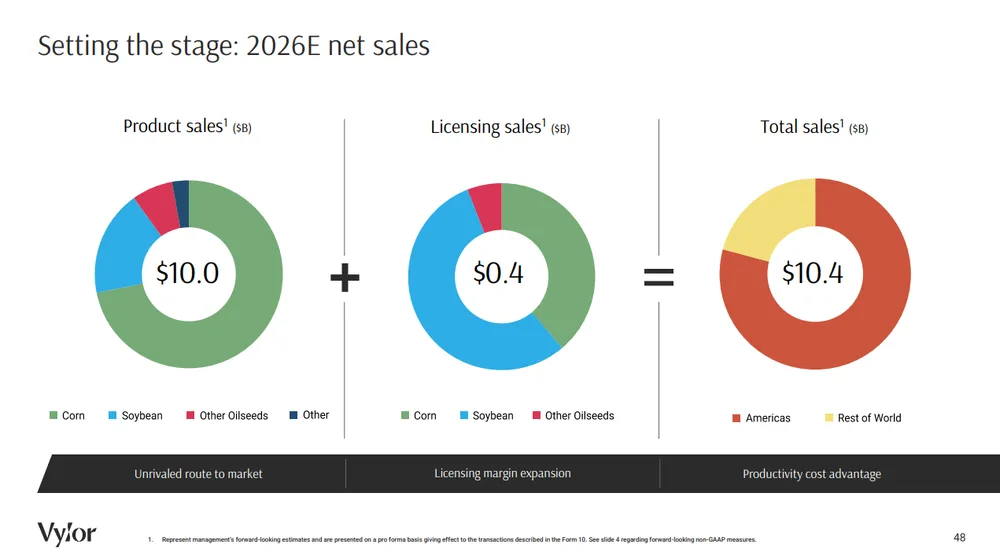
On its first Investor Day, Vylor unveiled a financial framework for 2027-2029, featuring a technology pipeline valued at $19 billion and a return to profitability in its licensing business. The company, which will separate from Corteva in 2026, anticipates a net revenue of $10.4 billion and an operating EBITDA of $3.3 to $3.7 billion by 2029, while launching several new technology platforms in the seed sector.
Source: Agropages, published under the title "Vylor Unveiled: $19 Billion Pipeline, Net Licensing Turns Po..." - 16 September 2026
Read more
The Scottish research institute James Hutton Institute has partnered with British agritech company AgriSound to make the pollination of fruit crops measurable and manageable. The project combines bioacoustic sensors and artificial intelligence to monitor pollinator activity and better understand its impact on yields, with the ambition of also guiding the selection of new varieties.
Source: Agropages, published under the title "The James Hutton Institute joins precision pollination proje..." - 15 September 2026
Read more
The Japanese startup Culta accelerates traditional varietal selection using AI and controlled environments, without genomic editing or GMOs. It claims to have reduced the development time for new strawberry varieties from ten years to two and is now preparing for international expansion, as well as entering the grape and apple markets.
Source: Agfundernews, published under the title "Can Culta take Japan’s premium fruit model global?" - 15 September 2026
Read more
The revision of patent law in Switzerland imposes a disclosure requirement for patented characteristics of plant varieties, thereby providing greater certainty to breeders in the development of new varieties. This measure, adopted by the Federal Council, aims to stimulate innovation by clarifying intellectual property rights and facilitating access to the European market for Swiss breeders.
Source: Agropages, published under the title "Switzerland – Greater legal certainty in plant breeding" - 11 September 2026
Read more