Anne BarratPublished on 29 September 2026

China has become the world's second-largest exporter of agricultural equipment, behind Germany and ahead of the United States. How far can its breakthrough go in Europe? In a note published on September 29, Jérémy Denieulle, director of studies at Agriculture Stratégies, and Sandrine Doppler, prospective analyst and economic intelligence expert, examine the ambitions of Chinese manufacturers and the obstacles they face in the European market.
Current events give a particular resonance to their analysis. From October 6 to 9, the Chinese manufacturer Zoomlion will present a complete range of tractors, including high-power hybrids, at the Sommet de l'Élevage de Clermont-Ferrand. This is yet another signal of a desire for conquest that, however, faces a paradox: Chinese manufacturers know how to produce powerful tractors, but they are struggling to establish themselves in this segment in Europe.
Beyond the competition among manufacturers, the note questions the strength of dealer networks, the implications of the right to repair and electrification, as well as the industrial dependencies of European agriculture. Here are the main insights from a thorough analysis that we invite you to read in full on the Agriculture Stratégies website.
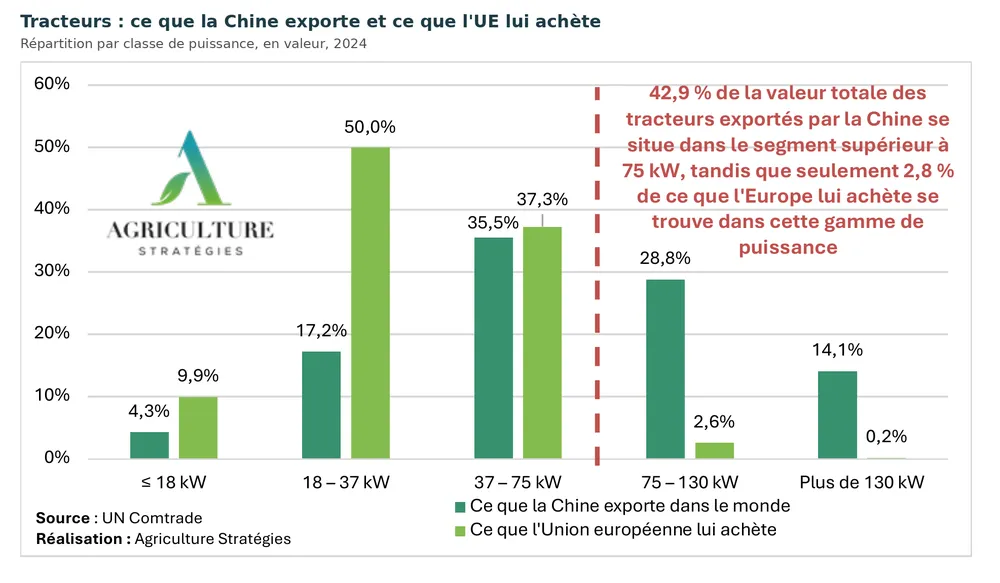
Between 2017 and 2025, European imports of Chinese tractors increased from €87.9 million to €567 million. Among the tractors imported from countries outside the European Union, China now supplies 47% of models ranging from 18 to 37 kW and 35% of those from 37 to 75 kW: machines intended primarily for market gardening, viticulture, and livestock farming.
Above 75 kW, however, its share has stagnated between 1% and 3% since 2017. Yet this is precisely where the heart of the European agricultural market lies: the standard tractor registered in France in 2025 develops an average of 166 horsepower, or 122 kW.
This ceiling does not reflect an industrial incapacity. High powers account for nearly 43% of the value of tractors that China exports worldwide, mainly to the post-Soviet space, the Americas, and other markets outside Europe. However, they only represent 2.8% of what the European Union purchases from China.
The lock is located elsewhere: in service and distribution. A farmer who buys a 150-horsepower tractor must also be able to rely on a technician and spare parts available nearby, for the ten to fifteen years that their machine will last. A breakdown during the sowing or harvesting period can cost much more than the repair itself. However, according to the Competition Authority, four manufacturers, namely John Deere, AGCO, CNH, and CLAAS, account for nearly 90% of the French market. Their dealer networks, organized notably around territorial exclusivities, constitute a barrier that is difficult for new entrants to overcome.
Unable to establish themselves directly in the European high-power market, Chinese manufacturers are multiplying their establishment strategies, leveraging several levers:
– Acquiring a brand and its network: Zoomlion has controlled the German manufacturer Rabe since 2020, thus recovering a historic brand, an industrial site, and a network of dealers.
– Relying on existing distribution networks: in Poland, Lovol is notably recruiting former dealers of the brands Ursus, Zetor, or Belarus.
– Organizing after-sales service: Zoomlion is developing a parts warehouse in Germany to supply the European market.
– Seeking public support: in Hungary, Zoomlion has obtained aid of about 18 million euros for an industrial investment of 110 million euros, dedicated to lifting equipment and not tractors.
– Recruiting European expertise: Chinese manufacturers are surrounding themselves with experienced professionals to master the commercial and regulatory specifics of the market.
Three developments are likely to weaken the lock of dealers and favor the arrival of new competitors:
- A weakened network. The French agro-equipment market has declined by 20% in two years. Struggling dealers may be tempted to diversify their offerings by welcoming new brands.
- The right to repair. In the United States, an agreement reached in July 2026 forces Deere to open access to its software and diagnostic tools more widely. A machine that is easier to repair could become a selling point for a new entrant.
- Electrification. By reducing certain mechanical maintenance needs and facilitating remote diagnostics, it could change the traditional role of dealers. A shift that Chinese manufacturers, already well-positioned in batteries, could take advantage of.
"Industrial dependence is not coming: it is already established," emphasizes Sandrine Doppler. European manufacturers indeed source some of their electronic components and batteries from China, while their software largely relies on North American technologies.
"Europe is thus doubly dependent: on North American software on one hand, and on Chinese hardware and raw materials on the other," she notes, before concluding: "The pertinent question is therefore not whether Chinese manufacturers will enter the European market, but what level of dependence Europe is willing to accept, and what happens to its agricultural sovereignty the day the flows are interrupted or weaponized."

Aurore Dupont - 13 July 2026

Aurore Dupont - 24 June 2026
Aurore Dupont - 17 June 2026