Anne BarratPublished on 16 March 2026
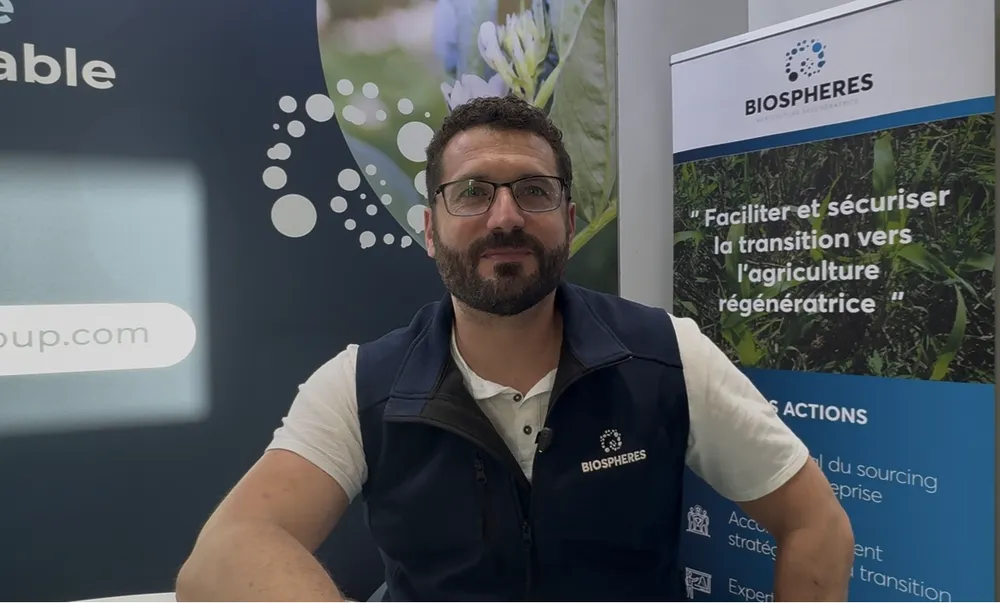
As regenerative agriculture gradually establishes itself in the strategies of major food groups and agricultural technologies multiply, a question arises: are these two approaches compatible? Yes, answers Sébastien Roumegous, founder of the Biosphères group, which, with its sixty collaborators, supports agricultural sectors in their transition to more resilient practices in about 25 countries. Its clients range from multinational agri-food companies to agricultural cooperatives and farmers. For the agronomist by training, an entrepreneur at heart, the challenge is not to choose between technology and nature, but to align innovation with the functioning of ecosystems.
Bloom Agritech: At a time when regenerative agriculture is very present in public debate, while technology is rapidly advancing in the agricultural world, how do you see their combination? Do the two approaches oppose each other?
Sébastien Roumegous: We often oppose two visions: techno-solutionism on one side and so-called "natural" agriculture on the other. At the extremes, they seem contradictory. One seeks to respect and enhance natural cycles, while the other stems from an industrial logic that sometimes simplifies biological processes or even circumvents them.
Take fertilization as an example: it can short-circuit the natural fertility of the soil by directly feeding the plant. But that does not mean it is incompatible with living soils, provided it is used intelligently and combined with organic matter management.
Regenerative agriculture ultimately consists of aligning with the functioning of nature: soil cover, organic matter management, reduction of unnecessary inputs, landscape infrastructures.
Technology can perfectly serve these objectives, provided it is calibrated to ecosystems. "We can only command nature by respecting its laws," said Francis Bacon. This is very true for agriculture. The biosphere took nearly five billion years to build these balances. We are very recent in the history of the Earth: our technologies must therefore adapt to these rules rather than seek to circumvent them.
" Our technologies must therefore adapt to the rules of the biosphere rather than seek to circumvent them."
So, does robotization and technology have its place, but under certain conditions?
The question is simple: does technology adapt to the ecosystem, or is the ecosystem forced to adapt to the machine?
Take weeding robotics. Some robots work better on perfectly leveled bare soils. To use them, you need to plow, work the land, and simplify the field. But a living soil needs plant cover, organic residues, and irregularities.
The challenge for roboticists is therefore to design machines capable of functioning under these conditions: covered soils, with straw, clods. A living soil is not a perfectly smooth surface. The real innovation will be to design robots capable of working in this biological complexity.
Technology is not bad in itself. It all depends on what we code into the machines and software. Technology must adapt to the laws of life, not the other way around. If it respects these rules, it will be beneficial. Otherwise, it will end up creating new problems.
" Does technology adapt to the ecosystem, or is the ecosystem forced to adapt to the machine? ? "
One of the goals of technology is also to industrialize agriculture. Can regenerative agriculture feed 9 or 10 billion people?
Yes, and in many cases it can even be more productive. The first step is often optimization. In many agricultural systems, for example, we observe 20% excess fertilizer.
In our programs, we often achieve 20% savings on fertilizers and 20 to 25% reduction in pesticides in the first year, without loss of yield. It’s not because we are superheroes, but often because there were simply 20% excess inputs in the agricultural systems. The first step of the transition is often optimization.
Then, we gradually redesign the system to improve the natural fertility of the soil. With richer soil, better water infiltration, and functional agricultural landscapes, productivity can be maintained or even increased.
Industrialization does not necessarily mean artificialization. It can also involve efficient and reproducible processes.
" In our programs, we often achieve 20% savings on fertilizers
and 20 to 25% reduction in pesticides, without loss of yield."
What types of clients do you support?
We work with a wide variety of actors: multinational agri-food companies like Nestlé, Danone, Mars, or Unilever, luxury groups like LVMH or Dior, but also mid-sized companies, agri-food SMEs, and increasingly, farmers directly.
Initially, we mainly worked with large groups. Today, the demand also comes from cooperatives and farmers.
" Initially, we mainly worked with large groups. Today, the demand also comes from
cooperatives and farmers."
How do you support companies and farmers in the transition to regenerative agriculture?
It is primarily a human adventure. Technical solutions often already exist, but their adoption takes time. We intervene on several levels: farm audits, farmer training, technical-economic workshops, experiments on pilot plots, and coordination of sector projects. The complete transformation of an agricultural sector generally takes between five and ten years. Concretely, the first steps often take three to five years, then an additional three to five years to stabilize practices. At best, a profound change takes five to six years, sometimes eight to ten years.
" The complete transformation of an agricultural sector generally takes between five and ten years."
The most difficult part is not the technique, but the change of habits. The history of science shows that changes take time. It took nearly 80 years for doctors to adopt handwashing between surgeries. In agriculture too, changing practices requires support.
Do large companies that engage in these processes do so mainly for their image?
We are well beyond marketing. In many groups, there are now dedicated agronomic teams. Initially, we mainly worked with sustainability departments. Today, it is increasingly the purchasing departments that are getting involved, because the issue is becoming strategic for the continuity of supplies.
The main motivation is securing supply. With climate change, agricultural raw materials are becoming more uncertain: water stress, declining yields, price volatility.
Investing in soil health, water, and biodiversity has become a question of economic resilience. There is a cost to acting, but there is also a cost to not acting. If doing nothing costs 600 million euros over twenty years, but transforming a sector costs 100 million, many companies prefer to invest today to avoid a supply crisis tomorrow.
" The most difficult part is not the technique, but the change of habits."
Biosphères is experiencing strong growth. What is your goal today?
I primarily want farmers to earn a better living while improving their environmental impact. Our success indicators are simple: less working time per hectare, more income for farmers, and a better impact on local ecosystems.
Our true client is agriculture. Agriculture occupies between 50 and 70% of terrestrial surfaces. It is the only activity capable of either degrading ecosystems or maintaining their health.
" Our true client is agriculture."
Anne Barrat - 22 September 2026
Anne Barrat - 4 September 2026
14 August 2026