Anne BarratPublished on 1 June 2026
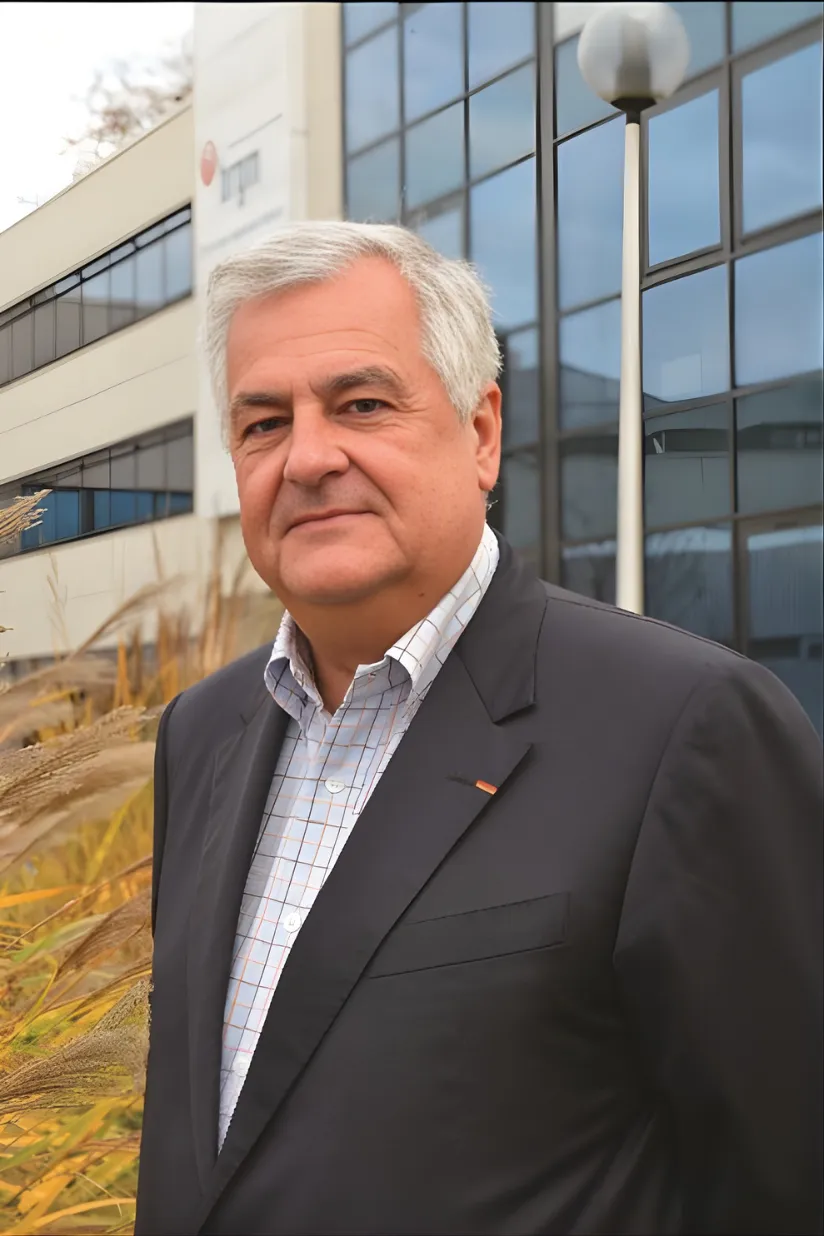
While most industrialists source from producers and traders in international markets, Jean-Paul Burrus has chosen to invest directly in the production of some of his raw materials. Cocoa in Ecuador, hazelnuts and almonds in Lot-et-Garonne, and perhaps vanilla tomorrow: the leader advocates a vertical integration strategy aimed at better controlling his supplies, the quality of his products, and value creation. This approach is still relatively uncommon in the chocolate industry.
Heir to a chocolate dynasty initiated in 1912 by his grandfather Fernand Burrus, Jean-Paul Burrus now heads Salpa (Société alsacienne de participations agroalimentaires), a family holding company that includes Schaal, an industrial chocolatier based near Strasbourg, as well as the brands Marquise de Sévigné, Yves Thuriès, and Cruzilles (see box). Interview.
Bloom Agritech: Why did you choose to verticalize your supplies?
Jean-Paul Burrus: The approach did not impose itself immediately, nor according to a perfectly structured initial plan. It was built gradually. We started with hazelnuts in 2001, with the idea of integrating our own production into praline manufacturing. At that time, we were still linked to a cooperative, which slowed down implementation.
Then, the reflection expanded: controlling raw materials allows for price stabilization, quality assurance, and sustainable differentiation from competitors who are entirely dependent on the market. In our business, the key raw materials are cocoa, hazelnuts, almonds, sugar, and then smaller products like vanilla. Producing everything ourselves is not realistic, but some sectors lend themselves to it.
For me, investing upstream serves primarily to be different. To do what others cannot easily do. Today, 100% of our cocoa comes from our plantations. And the same logic applies to hazelnuts and almonds.
" Investing upstream serves primarily to be different. To do what others cannot easily do. "
Has quality played a driving role in this verticalization strategy?
Yes, of course. We work in high-end segments. On one side, there is a network of premium boutiques; on the other, a B2B activity focused on artisans and chocolate retailers. In both cases, our positioning imposes a high level of quality requirements.
Initially, there was also a form of desire. An intuition. It was not solely a rational decision. For cocoa, for example, we first produced locally before it became a real group project. Mastering the entire value chain mechanically strengthens value creation.
Your family has been in chocolate for a long time. How did this story begin?
Our family history dates back to the early 20th century. My grandfather founded a first chocolate factory in Lorraine in 1912. The company was then rebuilt in Dijon after the war and passed on to my father. Later, my father bought another chocolate factory in Strasbourg. I took over in 1981.
At my grandfather's time, we bought beans from traders. The logic was that of traditional business. We introduced verticalization much later.
In hindsight, do you consider that verticalizing was the right decision?
Absolutely, and for two reasons. First, because it gave us a very distinctive positioning. Second, because, even though it was not the initial goal, the recent surge in cocoa prices has given us a considerable competitive advantage.
When bean prices rise to extreme levels, those who buy everything on the market have no choice: they pass the price increase on to their customers. We, however, have raised our prices less than others. This has allowed us to gain new market shares while strengthening our positions. It is a long-term strategy.
" When bean prices rise to extreme levels, those who buy everything on the market have no choice: they pass the price increase on to their customers. " .
Are you now completely self-sufficient in cocoa?
Yes. We produce about 1,500 tons of cocoa per year, which covers all our needs.
And for hazelnuts?
We are also self-sufficient, except for climate accidents. The hazelnuts come from Lot-et-Garonne. We cultivate about 540 hectares, including 300 hectares of hazelnut trees, with new plantations underway. In a normal year, we produce around 600 to 650 tons in shell, with a target of about 1,000 tons in shell in the long term, which is about 500 tons of shelled hazelnuts. This is sufficient for our needs; we even sell some externally.
Why did you bet on French hazelnuts?
First, we need to correct a misconception: France has never been a major global producer of hazelnuts. The historical leader is Turkey, far ahead. Next are Italy, and today countries like Chile or Oregon.
France remains a small producer. But that does not prevent building a quality supply chain, with traceability, proximity, and agronomic control. In our case, hazelnuts made sense because they directly entered our core business, especially for praline.
Speaking of traceability: has it become a decisive advantage?
Today, yes. When we invested in Ecuador in 2014, the question was not posed with the same intensity. Now, with new European standards, requirements on deforestation, compliance, and traceability, we are well ahead.
For us, compliance has not been a difficult issue, precisely because we control production at the source.
In this logic of upstream control, are you exploring other strategic raw materials besides cocoa and nuts?
Yes, we have started to develop a vanilla supply chain. It is still recent. We encountered some difficulties, particularly related to excess water on a plantation, which forced us to replant. But we have already produced some initial volumes.
We are working on Tahitian vanilla. It is a very interesting crop, but very demanding. Pollination, drying, aging: all of this requires a lot of attention.
Can vanilla be industrialized or automated?
Not totally, no. Some steps can be mechanized or automated, but it remains a very labor-intensive crop. This is one of the major issues when imagining greenhouse models or production outside the basins.
" In the eyes of the consumer, South and Central American cocoa is perceived as more qualitative than African cocoa. "
Has the question of cost and production conditions also influenced your choice to locate your cocoa plantations in Ecuador rather than Africa?
Yes, these elements clearly weighed in the decision, even if they are not the only ones. The first reason is very simple: in Africa, you cannot buy land in the same way. This is already a major argument. The second relates to image: in the eyes of the consumer, South and Central American cocoa is perceived as more qualitative than African cocoa.
Finally, the infrastructure and operating conditions there are, at least in our area, much more compatible with the type of agriculture we wanted to develop. Not to mention that I am very attached to South America.
Your plantations have nothing to do with the classic African model?
No, nothing to do with it. We are in a logic of structured, mechanized, irrigated, drained, and monitored agriculture. The smallest plots are 20 hectares. We use drones for certain treatments, GPS, electric tools for pruning, and spraying systems for inputs.
But it is not just about technique. My goal from the start was also social: to create an agriculture we can be proud of, that we can show to customers. With decent working conditions, health supervision, organized meals, and appropriate equipment. The best ambassador of our know-how remains what we show.
Do you think the African cocoa model is sustainable?
No, not in its current state. The problem is multifaceted: the level of remuneration for producers, lack of infrastructure, low productivity, sometimes failing governance, and difficulty in disseminating good agronomic practices.
When a crop does not yield enough, producers have no reason to invest in productivity. However, it is impossible for a system to modernize if its economic base does not allow it. This is compounded by very low yields, where other regions achieve much higher.
In the long term, if some South American countries or Brazil significantly develop their production with real agronomic control, this will mechanically weigh on global prices. If, on the other hand, methods do not change, part of the African model will be weakened.
" The future of premium cocoa is in South America."
In this production context, you have chosen CCN51, which is controversial. Why?
CCN51 often suffers from a bad reputation, largely unjustified. In Ecuador, it is frequently opposed to Nacional, considered more noble, while CCN51 is perceived as more productive but less refined. In reality, this distinction deserves to be nuanced.
CCN51 was developed to better resist diseases, particularly witch broom disease. When I arrived in Ecuador, I wanted to buy Nacional, but I encountered the fact that large plantations practically do not exist. Nacional is mainly cultivated by small farms.
On the other hand, we found a producer capable of achieving very good fermentation on CCN51, with remarkable results. And there, everything changes.
You mean that quality depends less on the variety than on post-harvest work?
The variety matters, of course, but it is fermentation that is decisive. We organized several blind tastings with very high-level professionals. Twice, a majority preferred CCN51 over Nacional.
The problem with CCN51 is also its name. It has a technical, almost pharmaceutical image, and carries a bad reputation linked to poorly processed batches. But a well-fermented CCN51 can yield excellent results, including in terms of aroma.
Is the future of premium cocoa at stake in South America?
Yes, clearly. South America has strong potential, both in quality and productivity. In Ecuador, we have high yields because everything is based on a coherent agronomic logic: irrigation, drainage, cultural management, varietal choice, regular maintenance.
The cocoa tree needs water, but also needs excess water to be drained. If you master that, you completely change the level of performance. We produce about two tons per hectare, which is incomparable to some African yields. This does not mean that Africa will disappear from the landscape, but that the centers of gravity may evolve. The future of premium cocoa is in South America.
Some people talk about and/or wish for a global governance of cocoa, modeled after OPEC. What do you think?
I do not believe in it. A cocoa OPEC does not make sense. Cocoa is a traded commodity, and there is no global agreement capable of sustainably managing its prices. Even among major producing countries, interests diverge. Everyone wants to produce more when prices rise.
This is the nature of agriculture: when prices soar, everyone plants. But a cocoa tree takes several years to produce. So, mechanically, we often end up recreating excess supply.
What do you think of chocolate substitutes, like Choviva?
I have tasted it. It is respectable, edible. But I do not believe in a sustainable revolution. Choviva arrived at a very particular moment: when cocoa prices exploded. This gave it an ideal media and commercial window. The product allows for something that visually resembles a chocolate bar, at an affordable price. It is clever.
But chocolate is not just a brown color and molded squares. Chocolate is an imaginary, a pleasure, a sensory promise. It is not a simple support.
" If the global cocoa supply reorganizes and prices fall or stabilize at more reasonable levels, the economic interest in substitutes will decrease significantly. "
So the enthusiasm will fade?
I am convinced of it. There are fashion effects in the agri-food sector. Some products emerge at the right time, ride a trend, and then fade. In my view, Choviva is more about this logic than a profound transformation of the market.
And if, as I believe, the global cocoa supply reorganizes and prices fall or stabilize at more reasonable levels, the economic interest in substitutes will decrease significantly.
Beyond these market issues, the cocoa sector is also facing increasing environmental and health constraints.
As the issue of cadmium, particularly in cadmium, receives increasing attention in Europe, is its presence in Ecuadorian soils a problem?
Yes, it is a real issue. There is cadmium in some soils in Ecuador, particularly in volcanic origin areas. Denying it would be absurd.
But it is a manageable challenge. We can act on pH, cultural practices, certain cover crops, inputs, and especially on analytical monitoring. We systematically control what we ship. We have even invested in specific equipment to analyze cadmium very early, directly at the plantation level.
Every year, we analyze soils, leaves, and beans. Today, we are well below European standards. But it is a constant point of vigilance.
If you had to summarize your vision in one sentence?
The chocolate of tomorrow will remain chocolate. Those who will do best will be those who master their upstream, their quality, and their agriculture.
If you had to summarize your vision in one sentence?
The chocolate of tomorrow will remain chocolate. Those who will do best will be those who master their upstream, their quality, and their agriculture.

Anne Barrat - 9 October 2026
Anne Barrat - 25 September 2026
Michel J. F. Dubois - 25 September 2026