Anne BarratPublished on 3 July 2026
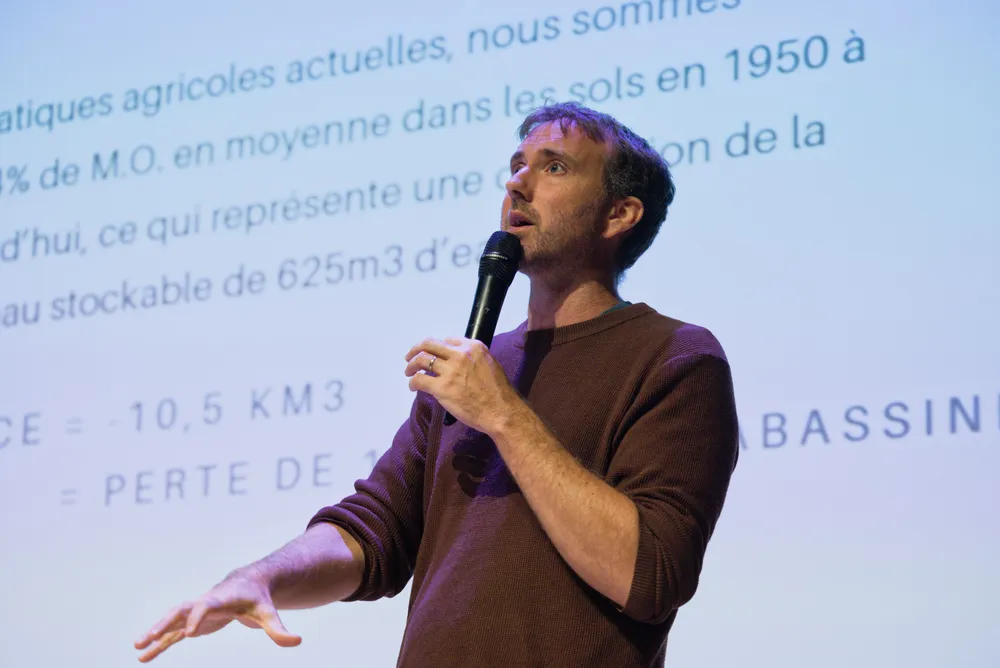
Invited to the 2026 edition of Cosm’Agri Business Day, held on June 9 in Lyon, Samuel Bonvoisin addressed a topic close to his heart: regenerative hydrology. An agronomist and co-author of Growing Fresh Water: From Rain Gardens to Regenerative Hydrology, he urges a shift in perspective on water management. According to him, it all starts with a better understanding of water cycles.
Understanding the Water Cycle Before Trying to Fix It
Most of us imagine a relatively simple cycle: water evaporates from the oceans, forms clouds, falls as rain, joins rivers, and returns to the sea. This representation is, however, incomplete, as it overlooks a key player: landscapes.
Trees, crops, meadows, forests, and soils do not merely receive rainwater. They also participate in the water cycle by returning moisture to the atmosphere through soil evaporation and plant transpiration. To better describe this phenomenon, Swedish hydrologist Malin Falkenmark proposed in the 1990s to distinguish between blue water, derived from the evaporation of oceans, seas, lakes, and rivers, and green water, produced by this evapotranspiration from landscapes.
This distinction profoundly changes the understanding of the hydrological functioning of territories. It shows that landscapes are not just passive receivers of precipitation: they are one of the engines of the water cycle. On average, more than half of the rainfall that falls on continents comes from this green water derived from soils and vegetation.
This perspective leads Samuel Bonvoisin to question a widely held idea: considering water as a fixed resource that simply needs to be better distributed. According to him, as long as we continue to degrade the landscapes that feed the water cycles, tensions over the resource can only worsen, risking real conflicts over its use.
In the face of increasing droughts, proposed responses largely rely on innovation: artificial intelligence, precision irrigation, drip systems, storage... Do you find this approach sufficient?
We are on the wrong track because we reason as if water were a fixed quantity that simply needs to be better distributed. This is a very reductive view. I like to say that water is not a cake to be shared. If we think of water as a cake, everyone will naturally seek to get the biggest piece or consume a little less than their neighbor. But if, at the same time, this cake continues to shrink because we are degrading the landscapes that produce water, we are heading straight for conflicts over its use, in other words, a real water war.
"Water is not a cake to be shared."
What do you mean by that?
I am absolutely not opposed to innovation. I am convinced that artificial intelligence, precision irrigation, or drip systems will further improve the efficiency of water use. There will undoubtedly be significant progress. But for me, that is not the main issue: these solutions address the symptoms without tackling the root cause.
The real question lies elsewhere: what are we doing with the water cycles? As long as we continue to degrade them, we can optimize our irrigation as much as we want, but we will continue to lose the capacity of landscapes to produce, retain, and recycle water. We will improve the management of a resource that will continue to diminish.
You oppose adaptation and regeneration. What is the difference?
These are two completely different logics. Adaptation involves trying to live with a deteriorating situation. Regeneration involves repairing the mechanisms that produce this degradation.
We can continue to perfect irrigation, develop reservoirs, or use artificial intelligence to save a few cubic meters of water. If, at the same time, landscapes continue to lose their capacity to retain and recycle water, these solutions will quickly reach their limits.
Adaptation is not a step in regeneration. If we do not devote as much energy to regenerating the water cycles as we do to adapting to their degradation, we will eventually reach the very limits of our capacity to adapt.
"Adaptation is not a step in regeneration."
Do mega-reservoirs illustrate this logic of adaptation?
They are a good example. The real water reservoir is not the one we build, but the one we have gradually degraded: the soil.
Each 1% increase in organic matter represents about 150 m³ of additional water per hectare. On a national scale, this corresponds to a storage capacity equivalent to nearly 6,000 mega-reservoirs. Conversely, by allowing soils to impoverish over several decades, we have lost the equivalent of about 15,000 mega-reservoirs of natural storage.
Note: a mega-reservoir is a large open water reserve, excavated and waterproofed, filled mainly by pumping from groundwater in winter for agricultural irrigation in summer. These structures, which can cover several hectares, are the subject of heated debates regarding their impact and resource sharing.
"The real water reservoir is not the one we build, but the one we have gradually degraded: the soil."
How did we get here?
We have methodically removed everything that slowed down and retained water in landscapes. We have uprooted hedges, eliminated ponds, straightened rivers, drained forests, paved cities, and impoverished soils. Each of these decisions responded to a particular logic. Together, they have profoundly degraded the hydrological functioning of our territories.
Today, we are trying to correct these imbalances with technical solutions, while we first destroyed the natural infrastructures that made these solutions unnecessary.
Where to start?
Agriculture represents nearly half of the French territory. If we want to act effectively, it is therefore naturally the first lever. This does not mean that we should neglect forests, waterways, or cities, but if I had to choose a starting point, it would be that one.
However, I believe it would be counterproductive to base this transition solely on farmers. Many are already under significant economic pressure and cannot bear such a large-scale change alone. We have also seen the limits of an approach based solely on individual initiatives. As with waste sorting, if only the most motivated engage, the effects will remain marginal.
That is why our association primarily addresses local authorities. We work with community groups, urban areas, departments, and water agencies to build local policies for regenerative hydrology. The goal is then to involve farmers in a collective approach at the watershed level.
Concretely, this means funding diagnostics, supporting farms, replanting hedges, restoring ponds, promoting the return of organic matter to soils, or rethinking certain hydraulic arrangements. We are already supporting several pilot territories in this approach.
One point is essential: we never propose a solution that would degrade a farmer's income. On the contrary, we ensure that the changes are compatible with the economic viability of their farm. Changes are built with the farmer, never against them. This is probably why we encounter very little hostility on the ground.
"Changes are built with them, never against them."
You also advocate for the return of mixed farming systems. Why?
Because livestock plays a much more strategic role than one might think in the functioning of water cycles. First, mixed farming systems create much more diverse landscapes. This diversity is essential for regenerative hydrology, as it promotes landscape roughness, slows down runoff, and improves water circulation.
Note: "Roughness" refers to the irregular character of a landscape – what Samuel Bonvoisin calls the "egg carton effect," made of dips and bumps. A varied landscape, neither flat nor smooth, slows down water flow, promotes its infiltration, and amplifies the return of moisture to the atmosphere, unlike a uniform landscape.
Furthermore, livestock allows for the local production of the organic matter essential for soils. Restoring this organic matter is one of the most effective ways to improve their capacity to retain water. It is also an issue of agricultural sovereignty: we must reduce our dependence on imported synthetic fertilizers and regain the ability to produce our fertility locally.
Finally, permanent meadows provide numerous ecological services. They store water, carbon, promote biodiversity, and enhance the resilience of territories against droughts.
When I talk about livestock, I am not defending the industrial model based on massive imports of feed. On the contrary, I advocate for extensive systems based on grass and integrated into mixed farming. For me, the future lies in this complementarity between plant and livestock production, which allows for the restoration of soils, landscapes, and water cycles.
Do forests also play a role in these cycles?
A major role, provided we consider them differently. A forest is not just a stock of wood: it is a motor of the water cycle. It must be diverse, both in species and ages. When all the trees are planted at the same time and reach the same height, the canopy becomes smooth and uniform. However, it is precisely the irregularity of the canopy – its roughness, made of dips and bumps – that maintains the return of moisture to the atmosphere. A smooth canopy weakens this dynamic; a varied forest, with trees of different ages and species, preserves it.
Additionally, there is another legacy: our forests have been massively drained, sometimes since the Middle Ages and especially since Colbert, to make trees grow faster and facilitate their management. Restoring their hydrological function therefore requires rethinking both the diversity of stands and these inherited arrangements.
"In a smooth canopy, the moisture return dynamic is diminished."
Can industries become actors in regenerative hydrology?
They have considerable levers. They can support their agricultural sectors, transform their industrial sites, de-pave their areas, restore vegetation, and integrate these issues into their purchasing policies. They can also raise awareness among their clients and support regeneration efforts wherever they source their supplies.
Note: De-paving means removing or replacing impermeable surfaces – concrete, asphalt, coated – that prevent rainwater from penetrating the soil, in order to restore natural infiltration and the return of water to aquifers and landscapes.
What message would you like to convey to decision-makers?
The real danger would be to believe that adaptation constitutes a sufficient political horizon. If we do not repair the water cycles, we will eventually reach the very limits of our capacity to adapt. The urgency is therefore not only to learn to live with climate change. It is to restore the ecosystems that still make this adaptation possible.
"The real danger would be to believe that adaptation constitutes a sufficient political horizon."

Anne Barrat - 25 September 2026

Michel J. F. Dubois - 25 September 2026

Anne Barrat - 24 September 2026