Anne BarratPublished on 9 October 2026
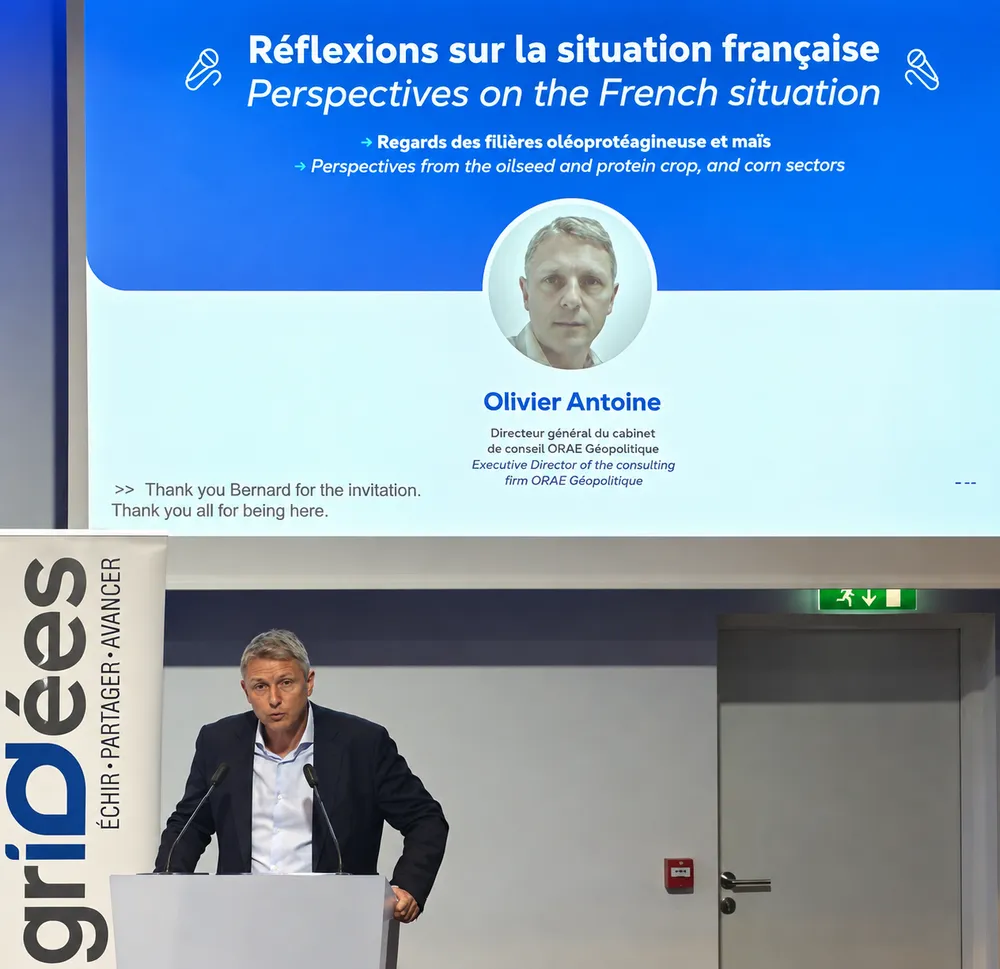
What would happen if Ukraine found peace? If the war settled in? If Russia won? These are the questions answered by Olivier Antoine during the Agridées back-to-school conference, "European Union/Ukraine: Evolution of Agricultural Negotiations." A doctor in geopolitics, Olivier Antoine heads ORAE Geopolitique, a geopolitical risk analysis firm that advises agricultural and agri-food companies, ministries, local authorities, chambers of agriculture, and international organizations. A specialist in agricultural and food issues, he is also an associate expert at the Demeter Club and author of The Geopolitics of Soy.
His presentation was based on a prospective study conducted in 2024-2025 at the request of the General Association of Maize Producers (AGPM). A study "not at all partisan," he insists, which crosses 19 indicators within three deliberately contrasting scenarios: the status quo, a full and complete integration of Ukraine into the EU without any safeguards, and a Russian victory. The second is acknowledged as maximalist, because "prospective is not a crystal ball." It is not about predicting the future, but measuring, sector by sector, where European maize would land if all barriers fell, from starch production to poultry. It is then up to professionals to draw the consequences: "I just do the calculations." A second part, dedicated to wheat and carried out for the AGPB, is to be presented in mid-October, and the exercise is also being conducted for Romania and Poland.
The orders of magnitude give a measure of the challenge. Ukraine produces three times more maize than France, at much lower costs. However, the starch producers, who buy 1.6 million tons of French maize, which is just over 10% of the national harvest, are "cost hunters": "If it’s cheaper, we will buy the cheaper one." These volumes could not necessarily be transferred to poultry. After its accession, Poland quadrupled its chicken production; applied to a Ukraine whose poultry production is already exploding, this scenario would eliminate "several million tons" of outlets for French maize.
A peaceful Ukraine integrated into the EU would therefore be equivalent to all of France's maize production being placed on the European market. Costs, processing, seeds, Black Sea corridor: Olivier Antoine details the risks for the French sector.
Bloom Agritech: Why is maize more exposed than wheat in the face of Ukraine?
Olivier Antoine: Because the balance of power is not at all the same. Depending on the year, France produces more wheat than Ukraine. In maize, this is not the case: we are facing one of the largest global competitors, and we are dependent on it. The balance of power is therefore unbalanced.
What would peace and integration into the European Union change?
Ukraine is already a very large producer. In peace and integrated into the EU, it would be able to significantly increase its acreage and production. We have estimated that it could place on the European market the equivalent of what France produces today. It would be a new France entering the market. This is huge, a real upheaval.
Would compliance with European standards not rebalance competition?
From my work on the subject, I do not believe so. Even under European standards, Ukrainian production costs will remain very low. Ukraine will not produce at the cost of France, Spain, Italy, or Germany. Moreover, it has these agroholdings, these gigantic farms that integrate all links in the chain. It is therefore capable of easily moving up the value chain and competing in the European market with all producers and all sectors.
Can quality protect European maize from this competition?
Some sectors, such as starch production or poultry, do not necessarily seek quality. Maize is a very malleable raw material; it is not wheat, where the protein content plays a significant role. I would address the question of quality mainly from the perspective of seeds, and it is concerning. Romania has lost a lot of seed acreage in recent years, particularly under Ukrainian pressure. France maintains a significantly higher quality. But a country that receives investments will also receive R&D in seeds. Where Ukraine currently competes on volumes and low costs, it could also compete on quality in the future.
What do you think will be the major issue after the war? Is the real risk in volumes or in processing?
The ability of Ukraine to increase its added value, and the speed at which it will do so. The previous Minister of Agriculture had this in mind: Ukraine currently processes 7% of its production, and it wants to increase to 25, then 30, 40, 50%, following the Brazilian or American model, with very clear ideas of first, second, and third processing. In the midst of war, this is unthinkable: a starch factory costs 200 million dollars and takes one to two years to build, which puts a target on your back. But in our post-war scenario, everything is possible: railways to European standards, ports, silos, starch factories, ethanol plants. If Ukraine moves up each level of processing with extremely competitive costs, it would destabilize European sectors already weakened by China or Brazil.
Which scenario do you consider the most likely?
For now, the status quo. The accession processes are still extremely long and complex. Fully integrating Ukraine would mean putting Europe in a declared state of war. If there is accession, I think it will be staggered, perhaps in the form of an associated state, with easier safeguard clauses to implement. But this status quo is no longer the same as it was a year ago. Russia has crossed a threshold in drone production. For our study on wheat, we have therefore integrated a degraded corridor in the Black Sea, and even a completely closed corridor. These are temporary costs, but if the war lasts, they become structural.
Is a closed corridor realistic?
We need to look at what Russia is doing: it is transforming its ports in Saint Petersburg and Murmansk to accommodate bulk carriers, with a rail transport of 3,000 to 4,000 km covered by the state. If it manages to export its grains through another corridor than the Black Sea, even at a higher cost, it means it will no longer fear condemning the Ukrainian corridor. Today, the two countries are neutralizing each other. This search for solutions is not peace.
You have also studied the hypothesis of a Russian victory. What would it mean?
Everyone dismisses this scenario, but we have written it very seriously. We have retained the "punishment" version: the large agro-holdings would fall into the hands of Kremlin associates, and the Ukrainian economy would be completely reprimarized. They would allow production, then export under the Russian flag or process in Russia. For wheat, the Russo-Ukrainian duo would represent 25 to 30% of the global supply: they would control the market. For corn, it is less concerning for Europe, which can turn to the United States, Brazil, or Argentina. And the primary outlet for processed Ukrainian corn, the European Union, would be closed to it.
What can the French sector do?
The options are simple: either we increase the competitiveness of French corn, or we help it face such a tidal wave, or we do nothing and accept the tidal wave. But we cannot act as if the tidal wave is not going to happen. That was the purpose of our work: to go beyond compilations of figures and measure, sector by sector, what the integration of Ukraine would concretely mean.
Michel J. F. Dubois - 25 September 2026
Anne Barrat - 24 September 2026
Anne Barrat - 30 July 2026