Anne BarratPublished on 14 September 2026
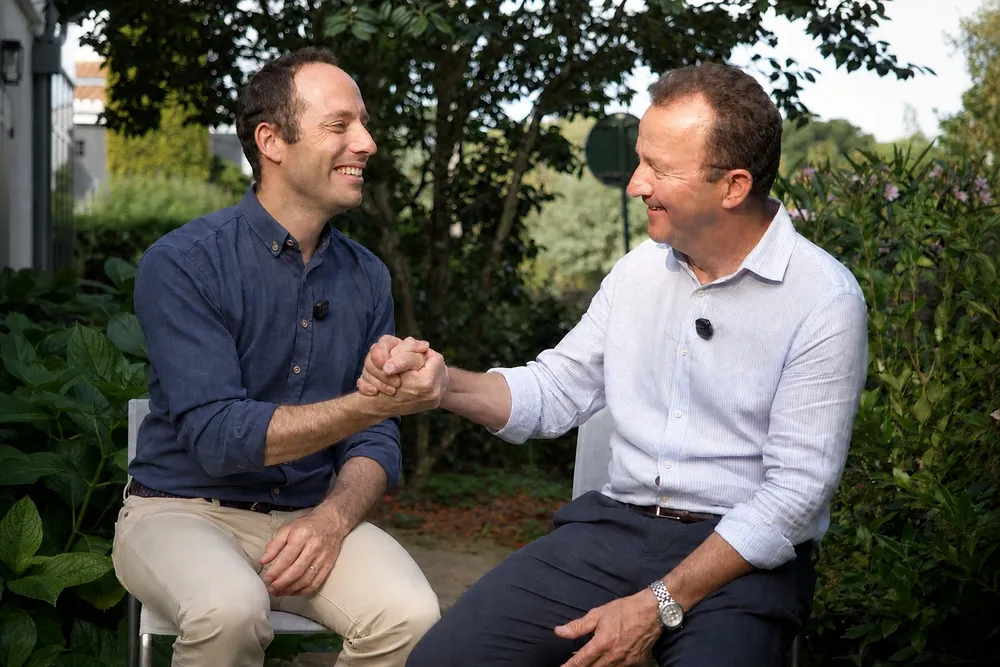
In an increasingly uncertain economic and climatic context, farmers often make decisions without measurement tools. The young company Cockpit Agriculture, born in Nantes within the start-up studio Imagination Machine, aims to address this with Cockpit, its "digital twin" for each farm. On the eve of Cockpit's commercial launch this autumn, co-founder Olivier Antonin, a farmer and agricultural engineer, along with polytechnician David Pineau, explains how AI can meet the needs of farmers and agricultural distributors: those of today, and those that these essential players in the agricultural value chain have not yet identified.
Bloom Agritech: Today, what is the main blind spot in managing a farm?
Olivier Antonin: Visibility. Farmers have to wait for their financial statements, between six and nine months after the end of the fiscal year, to know what has really happened. They make decisions based on data that is sometimes eighteen months old. They know their yield, rarely their margin, and almost never on a plot-by-plot basis. In an unstable world, they make heavy choices without a real dashboard. And they are not alone: a large part of the agricultural chain also operates with a time lag.
"Today, farmers know their yield, rarely their margin, and almost never on a plot-by-plot basis."
Why do agricultural distributors also struggle to support their members?
They experience the same uncertainty, on a different scale. Their job is advisory, but this advice still largely relies on trials, technical references, or averages, rarely on the actual economic performance of farms. Everyone has understood that artificial intelligence will change the game, and many are questioning how to use it. Some are already using it to improve internal productivity. However, none had found a way to enhance the quality of advice given to farmers through data.
Is this dual observation what led to the creation of Cockpit?
Exactly. We started with a simple idea: if farmers and their agricultural distributors lack visibility, we need to provide them with a tool that finally allows them to measure, compare, and anticipate.
How does Cockpit Agriculture meet the current needs of farmers?
By providing them with what no tool has offered until now: a digital replica of their farm. We allow them to see precisely where they are making or losing money, down to the net margin of each plot. We are not selling an additional dashboard: we are giving farmers the means to make their decisions based on objective data.
You also claim to address needs that farmers have not yet identified. Which ones?
This is the strength of the digital twin. Today, it allows understanding the performance of a farm. Tomorrow, it will enable testing different scenarios before implementing them: modifying a crop rotation in response to climate change, deciding on an investment, measuring the economic impact of a new technical choice, a new crop, a new agricultural practice, or monitoring their campaign in real-time rather than discovering it several months later. Our ambition is to change the way decisions are made.
"We are not selling an additional dashboard: we are giving farmers the means to make their decisions based on objective data."
How does Cockpit work in practice?
We automatically collect data from the farm, with as little manual input as possible. In about fifteen minutes, the artificial intelligence organizes and presents it in the form of dashboards at three levels: the farm, the crop, and the plot.
Our true innovation lies in calculating the net margin plot by plot. We retrieve the plot data and rotations; yields are reconstructed using satellite images, then cross-referenced with accounting to accurately allocate costs. This combination of technical and economic data is our main differentiator.
Why choose to go through agricultural distributors and traders rather than marketing Cockpit directly to farmers?
Because artificial intelligence only makes sense if it relies on rich and coherent databases. In agriculture, comparisons are only valuable between farms subjected to comparable pedoclimatic conditions. Agricultural distributors are best positioned to build these reference communities. They maintain a close relationship with farmers and have a real capacity for engagement.
What interest do they find in it?
Cockpit is based on two inseparable value propositions. The first concerns the farmer: in exchange for their data, they receive a completely new perspective on their farm.
The second concerns the distributor: by aggregating anonymized data from many farms in the same area, they gain access to what we call "augmented advice." When a farmer encounters difficulties on a plot, their distributor can compare their situation with hundreds, even thousands of similar plots and identify the factors that explain performance gaps. The advice is no longer based solely on experimentation: it relies on the economic and technical reality on the ground.
How did you validate this approach?
Through a co-construction phase. In 2025, five cooperatives and trading companies committed to recruit 10 to 20 farmers each and co-finance the project. In total, eighty farmers participated in this first stage.
It also allowed us to address a crucial question: yes, farmers are willing to share all their data, including their accounting. Under three conditions: understanding the full value of the digital twin, benefiting from a contract guaranteeing data anonymization, security, and usage, and finally, relying on a trusted third party. The data is not entrusted to the distributors; it is entrusted to Cockpit.
"Advice is no longer based solely on experimentation: it relies on the economic and technical reality on the ground."
What is your business model?
Our offer is sold through cooperatives and trading companies. The distributor presents Cockpit ; the farmer who wishes to use the platform then subscribes to a plan, ranging from 400 to 1,000 euros per year depending on the size of their farm, with an average level around 600 euros. The distributor is compensated by a commission on the subscriptions.
Thus, Cockpit only makes sense at a large scale. Where do you stand today?
We have gone from six to eleven signed distribution contracts, with a goal of about fifteen by October. Our partners already cover most of the French grain-producing regions. Our objective is to quickly reach a thousand farms. The richer the database becomes, the more relevant the analyses are: it’s a virtuous circle. The next step is to convince the leaders of agricultural distributors to integrate Cockpit into their transformation strategy.
The summer of 2026 was particularly difficult for farmers. What can Cockpit Agriculture bring in the face of such a crisis?
Many are considering putting some plots into fallow today. However, this decision can have counterproductive economic consequences: fixed costs are then spread over a smaller area, which degrades the profitability of the other plots.
Cockpit allows for precise measurement of these effects and exploration of other scenarios before making a decision, for example by simulating the integration of new crops into the rotation and their economic consequences at the farm level. Behind every abandoned hectare, there is of course the margin of the farm, but also the activity of agricultural distributors and, more broadly, our food sovereignty. Our goal is not to encourage production at all costs; it is to enable farmers to make informed decisions.
"Our goal is not to encourage production at all costs; it is to enable farmers to make informed decisions."
How far can this approach go?
Today, Cockpit establishes a diagnosis. Tomorrow, it will support the daily management of the farm. With the arrival of electronic invoicing, accounting data can be continuously updated. Farmers will thus track, in real time, the evolution of their gross operating surplus, plot by plot, and can adjust their decisions throughout the season. We want them to be able to test their choices in a digital environment before deciding in the field.
Who drives this ambition?
Cockpit was born from the meeting of two very complementary profiles. David Pineau, a 37-year-old polytechnician, worked for about ten years in the nuclear sector on predictive models of data analysis applied to power plants. Coming from a family of dairy farmers in the Nantes region, he wanted to put this expertise to the service of agriculture.
"We want them to be able to test their choices in a digital environment before deciding in the field."
For my part, I am a farmer in large-scale crops in the Garonne valley, an agricultural engineer, and I have spent most of my career in agro-supply. He brings data mastery; I bring field and supply chain expertise. Our ambition is not to develop an additional tool, but to sustainably bring agriculture into a new way of making decisions.

Anne Barrat - 10 July 2026
Aurore Dupont - 24 June 2026
Aurore Dupont - 21 May 2026