Aurore DupontPublished on 21 May 2026
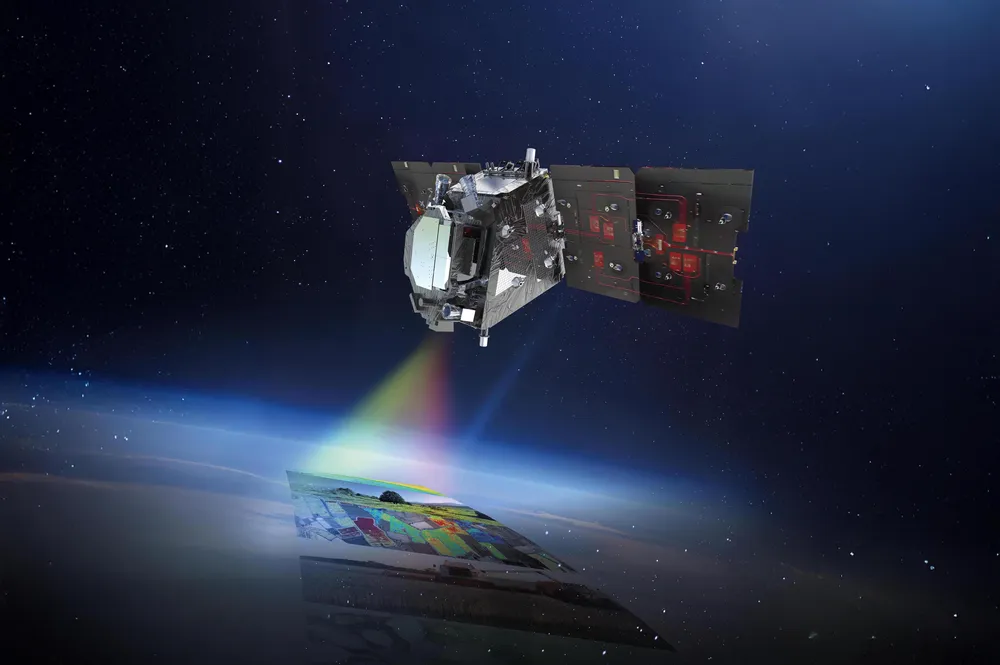
Observing photosynthesis from space: this is the ambition of the Flex satellite (FLuorescence EXplorer), designed and manufactured by Thales Alenia Space.
A joint venture between the French Thales and the Italian Leonardo, the manufacturer has laboratories in Cannes, where the device was assembled. Its central instrument, a spectrometer named "Floris", will soon be capable of mapping the fluorescence of vegetation on a global scale by decomposing light.
A direct link between photosynthesis and fluorescence
"Fluorescence is the closest measure we have of how the photosynthesis mechanism works, observable from space,” explains Marco Celesti, an optical imaging researcher at the European Space Agency (ESA) and one of the project's initiators.
During photosynthesis, plants emit a very weak fluorescent signal, invisible to the naked eye, which varies according to environmental conditions (intense droughts, floods, presence of pests...) and their health.
The role of "Floris" will be to "quantify photosynthetic activity in relation to the environmental stress experienced by plants,” summarizes Thales Alenia Space. In other words, it will allow for measuring the stress state of plants and their reactions in a given area, with a resolution of 300 meters (each pixel representing a 300 × 300 meter area on the ground). An unprecedented level of precision for this type of observation. Depending on the latitude, Flex will pass over the same location every 10 to 28 days.
“An enlarged view of specific areas”
"We can work on a large scale, in terms of spatial extent, meaning we can observe the entire globe repeatedly over time. At the same time, we can obtain a sort of enlarged view of specific areas when we need it,” details Marco Celesti. He also emphasizes the importance of having a dedicated instrument that can observe all colors of the signal: "there is not just one color of fluorescence, but several shades in the red and near-infrared, which provide different information about photosynthesis".
This level of detail could interest other researchers working with Europe to strengthen the application of the continent's regulations on deforestation. According to Michel Dubois, a leading expert in agricultural sciences at UniLaSalle University, by observing the wavelengths emitted above a forest, it will become possible to determine the species present, or at least, to assess their diversity and density. A primary native forest, for example, will show "a fairly large variability in fluorescence, depending on the species present,” he indicates. Conversely, a forest that has been cleared and replaced by a monoculture of oil palms would emit much more homogeneous wavelengths.
Better understanding the carbon cycle
Beyond plant stress, Flex is also expected to improve understanding of carbon circulation between vegetation and the atmosphere, as well as the effects of photosynthesis on carbon and water cycles.
While the carbon cycle is now well documented, uncertainties remain, as Marco Celesti points out: "we have studied the subject extensively and used fifty years of time series on the 'greenness' of plants to understand better. But when it comes to how plants react to stress events on a regional and global scale, we still do not know enough to make accurate predictions".
Anticipating plant reactions
If it became possible to anticipate plant reactions to environmental stress, this research would likely find concrete applications quickly. If the link between fluorescence and plant health is validated, "we can imagine doing something much more calibrated, operational, and that would allow us to offer monitoring services, and then optimize agriculture,” explains Thierry Huiban, the project director at Thales.
"Everything related to crops is a matter of human survival if we are a bit pessimistic,” he adds. It is therefore about identifying "early signs that indicate the plant is doing well. We can imagine, behind this, arriving early enough to measure stress as soon as possible, and not waiting for the plant to be dead to realize it has been stressed and lose the harvest".
Concrete applications
Charles Vaury, soil health director at Syngenta, already sees very concrete applications: "if tomorrow we can say, when we have a certain level of signal, that there is a fungal pest attacking the plant, we will be able to train the model and verify that it is always true. And in 95% of cases, when we have this signal detected, ideally in advance, we can say watch out, there is a pathogen attack, we need to treat, we need to intervene.” But for him, satellite measurements are not enough. They will need to be coupled with field observations, without neglecting farmers' experience with their own crops: "by observing a wheat leaf, they know how to detect signs of rust, and how to treat it".
Nevertheless, being able to predict harvests can become a major asset for farmers to better value their production. If, for example, "a harvester knows he is going to have a very good harvest, but that collectively it will be poor, he has an interest in storing his production,” specifies Michel Dubois. "And at that moment, the challenge will be to inform the entire agricultural world about this new tool that is being put in place".
An imminent launch
In June 2026, Thales Alenia Space is expected to obtain permission to join Kourou, French Guiana, for final tests to prepare for the launch and orbiting of the satellite, scheduled for September. The first six months will be used to calibrate the instruments, after which ESA scientists will have at least three years to exploit the data.
If the results are conclusive and assuming the instrument is democratized, the development and orbiting of a new satellite would require at least five years.
Sandrine Doppler, Éric Sargiacomo, Frédéric Courleux - 5 October 2026
Anne Barrat - 14 September 2026
14 August 2026