Anne BarratPublished on 12 August 2026
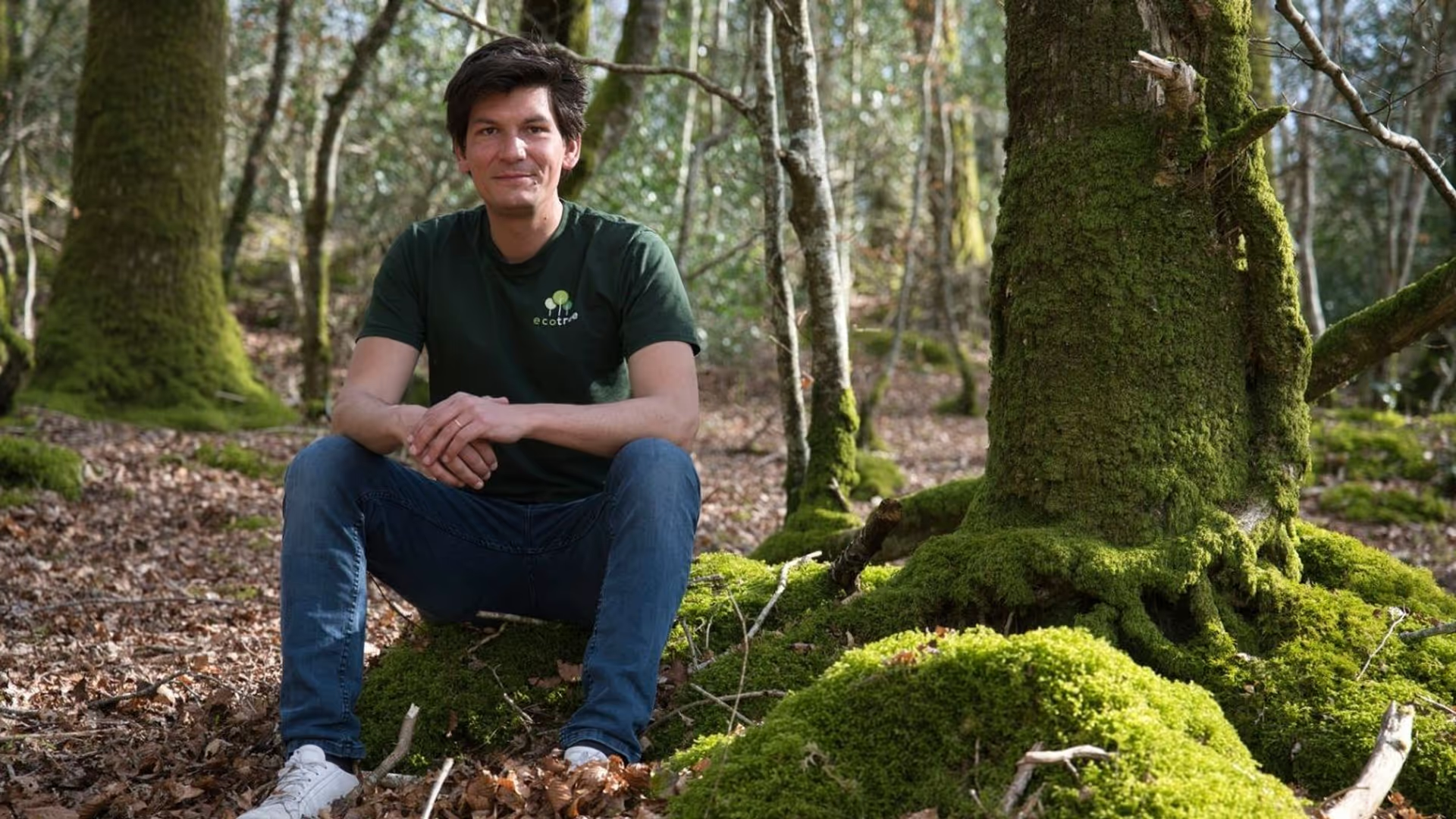
Twenty-five years since the carbon credit mechanism was established, there have been just as many years of promises and controversies. Erwan Le Méné knows this market from the inside. A specialist in the valuation of natural assets, he develops forestry carbon credit projects and supports investment funds committed to financing forests. In this interview, he offers a blunt assessment: "there is no money in the forest." His conviction is equally strong: no tool, whether carbon credits, voluntary markets, or public funding, will be sufficient on its own. To restore forest ecosystems, we will need to learn to combine them.
Bloom Agritech: You meet daily with forest owners as well as the funds that buy their woodlands. Does restoring or adapting a forest really cost that much?
Erwan Le Méné: Much more than it seems, and the primary problem can be summed up in one sentence: there is no money in the forest. Our daily work involves meeting owners who have inherited a plot from their grandparents, often small, barely a few hectares. At sixty years old, they receive just 800 euros in retirement and learn that they would need to spend around 400,000 euros to finance reforestation. Forestry investment is thought of over half a century: families simply cannot bear it. And virtuous management, mixed and diversified, costs more and yields less than monoculture. There is no miracle: it’s like in agriculture, where planting hedges and diversifying crops increases the bill.
" Forestry investment is thought of over half a century: families simply cannot bear it "
Aren't carbon credits precisely designed to provide this money?
The principle is appealing: a high-emission company first reduces its emissions, then compensates for what it cannot eliminate – its residual emissions – by financing projects that sequester carbon. Europe has committed to net zero by 2050 for all its emissions. But a carbon credit is just a mathematical calculation, and this calculation does not account for the ecological quality of the project. As a result, it can reward exactly what should be prohibited.
What do you mean?
This is the entire ambiguity of the system. On the same hectare, a monoculture of conifers generates more credits than a mixed forest: conifers grow twice as fast, at a rate of 2,000 trees per hectare: more trees, therefore more carbon captured. A company can thus finance, in good conscience, this type of plantation at twenty euros per ton. However, forest monoculture is the equivalent of intensive agriculture: pesticides, depleted soils, collapsed biodiversity. Under conifers, birds no longer nest, bark beetles no longer encounter predators and proliferate. Poorly designed carbon credits finance the mistakes of the past.
" Poorly designed carbon credits finance the mistakes of the past "
Do tax aids not compensate for this bias?
They exist: the Sérot-Monichon law provides that owning a forest entitles one to tax reductions and exemptions on inheritance rights. But they have long perpetuated the same flaw. Fifteen years ago, an owner could clear their forest, sell the wood, and then have the replanting financed by carbon credits: they would cash in twice, once on the sale of the cut, and a second time on the credits meant to pay for reforestation. And, most often, these owners were already wealthy: it would have been paradoxical for a large industrialist to finance the restoration of an already considerable asset. The state has tightened the rules – requiring replanting within two years under penalty of losing the tax advantage, ineligibility of cuts already compensated – and that is a good thing. But regulating does not create money. The question of financing remains unresolved.
" Regulating does not create money"
What avenues do you find most promising today?
The first involves a new instrument that we have been calling for for years and which is finally arriving at the European level: the "nature" credit, or biodiversity credit. The idea is to add to the carbon credit a biodiversity index and an adaptation to climate change. A plantation can show a lot of carbon and a very low ecological index, without changing practices. The biodiversity credit, set to become mandatory alongside carbon, provides a price supplement for good projects — so that those who do well are no longer disadvantaged compared to those who do poorly. This is the direct correction of the paradox.
And the second?
The financialization of the forest asset. Since fragmented families do not have the necessary financial surface, we must seek it where it exists: in funds. My main job today is to be an operating partner of financial companies convinced that forests will be worth a lot in ten, fifteen, or twenty years. We buy degraded forests — thus inexpensive, as the negotiation position is favorable — we have the means to restore them, and we reconstitute woodlands. This is the so-called "value add" approach, like in real estate: buying a dilapidated property, renovating it, and increasing its value. Large investors, such as Mulliez, Amundi, or Ardian, to name a few, are building portfolios of natural assets intended to be sold in twenty or thirty years. A damaged forest is worth about 10,000 euros per hectare, a premium forest 20,000, a burned forest 3 to 4,000.
" Forests will be worth a lot in ten, fifteen, or twenty years "
Does this diagnosis apply only to France?
This is a European problem. What distinguishes the countries is the share of public ownership. The French exception is that 70% of forests are owned by private owners, often fragmented and impoverished. In Romania, the proportion is strictly the opposite: 70% belong to the state. Neither is an automatic guarantee of good health — it all depends on who manages it, and how.
If you had to summarize the recipe?
There is no miracle tool. No lever is sufficient on its own: a bouquet is needed. Tighten the fiscal rule to stop subsidizing bad practices; add a biodiversity credit to the carbon credit that finally rewards good projects; and bring in patient capital, capable of buying and restoring the forests that families can no longer maintain. Together, they can finally put money where there has never been any.
" Finding patient capital, capable of buying and restoring the forests that families can no longer maintain. Together, they can finally put money where there has never been any "

Anne Barrat - 25 September 2026

Michel J. F. Dubois - 25 September 2026

Anne Barrat - 24 September 2026