Anne BarratPublished on 30 July 2026
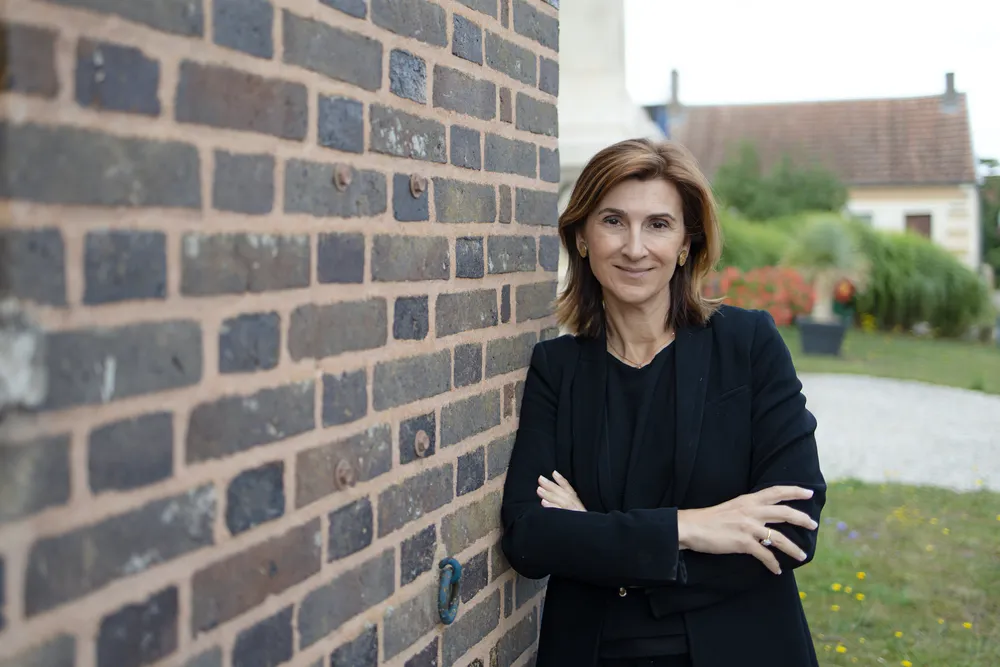
Having passed through the agri-food sector and then wine cooperation, Sabine Verley has made the "sector" her battle horse. No longer the technical chain that goes from field to shelf, but an ecosystem where producers, processors, researchers, and investors (both public and private) come together. A demonstration, from the Gascon vine to the olive groves of Aude.
"The only scale capable of shifting economic lines is that of the collective," believes Sabine Verley. "A small individual who creates his own olive trees will sell them locally. But what is needed is volume. And to have volume, there must be collective strength. A strength that is somewhat political." She immediately clarifies this "political" dimension: a sector weighs "like an AOP or a union can, because it has an existence." A legal existence that allows it to negotiate, to exist as an interlocutor, and, above all, to access funding, particularly European, that is out of reach for a single producer. The mechanism can be summed up in one sentence: "Individuals bring their innovative, unique side to the group; and the community shines a spotlight on people who, individually, could not survive."
Because solitary trajectories remain exceptions. Michel Soufflet, founder of the group bearing his name, Gérard Bertrand "Men with strong character who built empires in a generation. But they are exceptions," she states. Conversely, when the collective disintegrates, decline sets in: Bordeaux, once a structured sector, has seen its identity diluted in a myriad of individual brands and châteaux. "Out of fifteen Bordeaux, who can say this one is good, that one is not? There is no longer any market reading," observes the consultant. The true engine of a sector, in her eyes: to unite, then share knowledge instead of keeping it to oneself: "when one actor progresses, he must be able to benefit others from his experience."
" Individuals bring their innovative, unique side to the group; and the community shines a spotlight on people who, individually, could not survive."
Because innovation often arises from lack: necessity makes law. The Gascon cooperative of Plaimont, where Sabine Verley spent five years, is proof of this. On lands that were long undervalued, it was impossible to live solely from wine, "it has always been necessary to be more innovative, to pedal faster, to survive, in fact, she recalls." As early as 2002, Plaimont created the first private ampelographic conservatory in France and saved ancient grape varieties whose late maturity and low alcohol content could, tomorrow, respond to water stress. The complete opposite of regions spoiled by rent: "too rich, and therefore not very creative," the consultant states regarding Bordeaux or Champagne of the past.
The constraint is not just economic: regulation itself becomes a barrier that the boldest break through. "Decrees confine us to percentages of grape varieties: as soon as we step outside, we no longer call ourselves Bordeaux," she explains. Some take the plunge to survive. In Médoc, the Australian Penfolds (a publicly traded group, Treasury Wine Estates), owner of châteaux since 2019, markets deliberately off-appellation Franco-Australian blends — to the point of vinifying and bottling them in Australia, as French regulations prohibit this transcontinental marriage. Her recipe for conquest, which the consultant praises: a long-term pedagogy, which first attracts young drinkers with an affordable entry-level product, before leading them, years later, to its "priceless" wines.
The same freedom is found with Numa Cornut, a winemaker from a family of winemakers from the South, who settled in 2020 in Volnay, Côte d'Or, to "do as he pleases for the best," praises Sabine Verley. If Burgundy is managing to stand out, the consultant emphasizes, it is because it has managed to preserve its micro-parcels, its clos and its villages, where other vineyards have allowed their reading to become blurred: a rare production, and a loyal clientele for exceptional products. "These are strong-minded individuals who do extraordinary things," she summarizes.
" These are strong-minded individuals who do extraordinary things"
However, structuring is essential: "small initiatives abound, but fail due to lack of organization into a sector, because moving forward alone is too complicated," warns Sabine Verley. Two trajectories illustrate this.
First, that of Alexis Muñoz, a Franco-Spanish olive oil expert who relies on a striking figure – "we only produce 3% of the olive oil we consume" – to develop an ambitious project to plant nearly a thousand hectares of olive trees in Aude, converting, along with others, fields and vineyards that climate and market conditions have rendered unviable. "He starts from an undeniable observation, he is in excellence: the land, the knowledge of the subsoil. There is a real intellectual construction, which goes from the land to the market," she praises. A substitution approach: producing here what we used to import.
"Small initiatives abound, but fail due to a lack of organization into a sector, because moving forward alone is too complicated"
Next is the Ferme Parthiot, born from a generational shift in Aube. "In the 1990s, the father, a visionary, undertook to go directly to the market or risk not being able to live off his work. Twenty years later, the son, an agronomist, reverses the approach and decides to group 120 producers to build a brand themselves," she recounts. From the family farm to the lentil sector: multiplied turnover, new outlets, exports. Plant-based proteins continue their rise in favorable markets. Others, like the Sea4Earth algae sector, are building the complete ecosystem – production, processing, R&D – even before the market exists.
The "alcohol-free" sector would also require an organized supply chain to support all these individual initiatives. Traditional sectors are reinventing themselves. Thus, what was once considered waste is now becoming a high-value ingredient, such as the apricot kernel unsuitable for the food sector, which is used for its moisturizing properties in the cosmetics sector. These are just a few examples that prove that agriculture is full of resources and must be supported to enhance its wealth.
The decisive obstacle remains. "In France, we are very strong in research, in which we invest. But once R&D is funded, we no longer help farmers to develop," denounces Sabine Verley. The rest is known: "The United States buys beautiful ideas that we do not know how to finance; we only know how to conceive them." Lacking support, the project leaders pay out of their own pockets – like this group of farmers who spent 25,000 euros on their marketing strategy alone.
The problem lies less in the volume than in the direction of funding. "In France, we do not fund the right things," she emphasizes: prestigious seats or off-the-ground market studies rather than development capital." She also likes to recount the retort of a journalist, during a cooperative general assembly, to a farmer nostalgic for past subsidies: "The CAP did not finance you. It gave consumers access to products at fair prices, amid inflation. That is not the same thing." Hence the urgency to innovate even in funding, like Terra Hominis, which makes ordinary individuals co-owners of vineyards to facilitate installation and transmission. "All of this works, she concludes. You just need to have the right idea and put it in order."
" In France, we do not fund the right things": prestigious seats or off-the-ground market studies rather than development capital "
Anne Barrat - 9 October 2026
Michel J. F. Dubois - 25 September 2026
Anne Barrat - 24 September 2026