La RédactionPublished on 6 February 2026
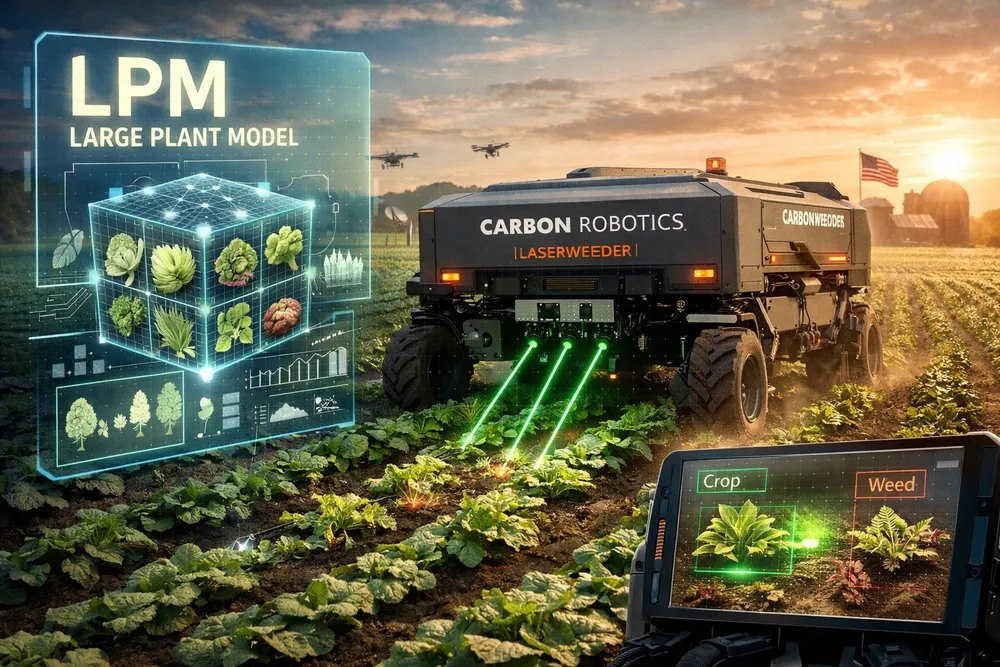
Founded in 2018 in Seattle, Carbon Robotics has established itself as one of the major players in precision agriculture with its LaserWeeder robots, capable of weeding without herbicides thanks to computer vision and lasers. Co-founded by Paul Mikesell, a serial tech entrepreneur, and Shay Myers, a farmer facing the challenges of large-scale weeding, the company embodies a new generation of AgTech: specialized, contextual AI systems that operate directly in the field. This dual expertise, cutting-edge engineering and intimate knowledge of the field, structures the DNA of Carbon Robotics: specialized, contextual AI systems that operate directly in the fields.
This complementarity has attracted investors. After several funding rounds, Carbon Robotics has raised approximately $157 million, including a Series D of $70 million announced at the end of 2024, with participation from NVentures, Nvidia's venture capital fund, alongside other international investors. The company is now reaching a new milestone with the launch of its Large Plant Model (LPM), an explicit transposition of the foundation model paradigm – AI models trained on massive volumes of data and capable of generalizing to new situations without being fully retrained – to the agricultural world.
Technically, the LPM marks a clear break from traditional agricultural vision approaches. Where existing systems relied on specialized classifiers, trained crop by crop, the LPM is designed as a generic model for recognizing living organisms, trained on hundreds of millions of plants. It learns morphological invariants, shapes, textures, growth stages, and generalizes to contexts it has never encountered. The result: a robot can be deployed in a new plot, for example in lettuce or onions, and become operational in a few minutes, without a long calibration phase, by adjusting its decisions directly in the field.
Already commercialized, the LPM is deployed via software update on the existing fleet of LaserWeeders. The investment remains high, several hundred thousand dollars per machine, often accompanied by service contracts, but the promise is now systemic: to automate a critical task in a context of labor shortages, restrictions on herbicides, and increasing pressure on the sustainability of agricultural practices.
With the LPM, Carbon Robotics sends a clear signal: AI applied to agriculture is no longer a tool for marginal optimization, but a strategic infrastructure operating directly in the field. This shift goes far beyond the technological framework and raises several structuring political issues.
First, the issue of substituting herbicides, which has become a public issue in its own right. Even when regulatory frameworks evolve, such as the withdrawal in 2024 of the European SUR proposal, environmental and legal pressure remains strong, driven by sustainable use, integrated pest management, and the proliferation of disputes over non-chemical alternatives.
Next, the issue of agricultural technological sovereignty. When the "brain" of the machines – models, data, software updates – is controlled by a few private non-European actors, dependence no longer only concerns inputs, but the very ability to produce: compatibility of equipment, access to agronomic data, evolution of practices driven by software.
Finally, the issue of regulation and competitiveness. In a context where the European Union is now regulating AI with the AI Act, which came into effect in the summer of 2024, the question becomes strategic: who develops, operates, and controls these models in the field, and according to what interoperability standards?
We can expect the emergence of a constellation of Large Plant Models, specialized by sector, climate, or production basin. These models could become the cognitive foundation of future agricultural machines, from weeding to targeted fertilization, from stress detection to autonomous harvesting, transforming equipment into learning systems. With, in the background, an eminently political question: who controls the models, the data, and the standards on which the agriculture of tomorrow will rely?

Anne Barrat - 14 September 2026

Anne Barrat - 10 July 2026
Aurore Dupont - 24 June 2026