Anne BarratPublished on 11 March 2026
As agricultural sectors become more complex, logistics emerges as a central lever for performance. In the cereal sector, competitiveness is no longer solely determined in the fields: it is now built throughout the value chain, from on-farm storage to industrial infrastructures and international markets.
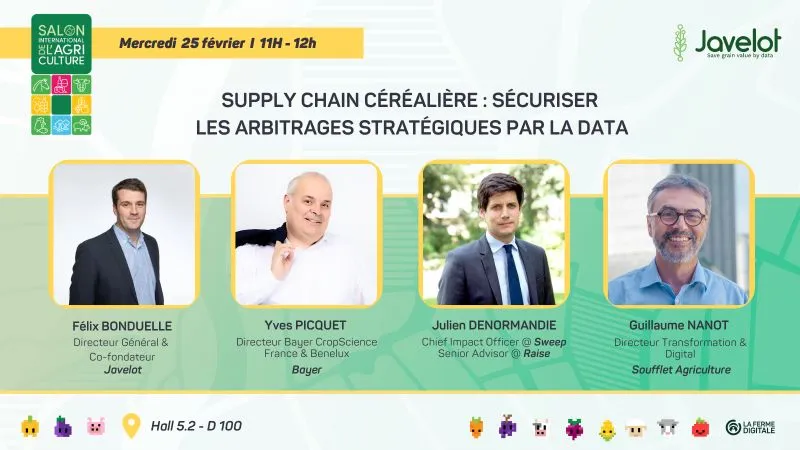
It is around these issues that La Ferme Digitale brought together several key players in the agricultural ecosystem during a roundtable held at the 2026 International Agricultural Show. Moderated by Emilie Boyon, CSR Director at Javelot, a company specializing in the digitalization of post-harvest operations and logistical optimization of cereal sectors, the discussion explored ongoing transformations in cereal flow management and the growing role of digital technologies. Four speakers shared their analyses: Julien Denormandie, former French Minister of Agriculture and now Chief Impact Officer at Sweep; Guillaume Nanot, Director of Transformation and Digital at Soufflet Agriculture; Yves Piquet, President of Bayer Crop Science France; and Félix Bonduelle, General Director of Javelot.
All agree on one point: in the face of increasing market volatility and traceability requirements, the ability to anticipate and manage flows becomes crucial for the competitiveness of cereal sectors.
Logistics as a Strategic Asset
For a long time, agricultural performance was primarily associated with production. Today, competitiveness depends not only on agricultural yield but equally on the ability to manage flows and logistics.
As Julien Denormandie points out: "In the price of an agricultural product, nearly half of the value corresponds to logistical operations, the other half being related to production. We do not say this enough." This logistical dimension includes the collection and transport of cereals; storage in silos or on the farm; preservation and quality management of grain; and delivery to processing industries or export ports.
" In the price of an agricultural product, nearly half of the value corresponds to logistical operations, the other to production" Julien Denormandie, Chief Impact Officer at Sweep.
Logistics thus appears as a major lever for value creation, particularly in a tense international context marked by the war in Ukraine and increased competition in agricultural markets. According to Julien Denormandie, the competitiveness of the French cereal sector relies on two factors: the relatively low cost of agricultural land and the quality of its logistical infrastructure. Optimizing the latter thus becomes a strategic priority.
A Long and Complex Logistics Chain
For agricultural trading players, logistical management is a daily challenge. At Soufflet Agriculture, one of the main European collectors, collection reaches about four million tons in France and relies on a dense network of infrastructures. "We have 250 silos in 33 departments, and their maintenance costs between 10 and 15 million euros per year," details Guillaume Nanot, Director of Transformation and Digital at the group.
The cereal logistics chain also operates on a long timeline. "Between the moment we harvest and when the product is consumed, it can take up to 13 months," he continues.
Additionally, a particularity of the French model is that nearly 50% of the collection occurs outside the harvest period, with farmers themselves ensuring an initial phase of storage on the farm. In a network that includes over 22,000 partner farmers at Soufflet Agriculture, this organization makes logistical planning and information flow particularly complex.
" For agricultural trading players, logistical management is a daily challenge."
Data: The New Key to Optimization
In the face of this complexity, digitalization and data utilization become essential. Sector players emphasize the need to integrate massive volumes of information: storage infrastructures, logistical flows, agronomic data, or requirements from industrial clients. "To optimize logistics, says Félix Bonduelle, General Director of Javelot, we need a colossal amount of data, some static like infrastructures and others very dynamic related to flows." The challenge is to integrate this information into tools capable of modeling and optimizing flows across the entire chain, from the farm to processing industries.
" To optimize logistics, we need a colossal amount of data." Félix Bonduelle, General Director of Javelot.
Measurable Economic Gains
Optimizing logistical flows through data is no longer just theoretical. It is already producing tangible results in several large organizations. At Bayer, implementing centralized data management and predictive analysis tools has significantly improved the performance of the global supply chain. "We aimed for 2 to 3% savings, we are now over 5%," rejoices Yves Piquet. Beyond financial gains, these tools also allow for better management of goods flows, anticipating logistical needs, and tracking the environmental impact of operations.
" We aimed for 2 to 3% savings, we are now over 5%" Yves Piquet, President of Bayer Crop Science France.
Anticipation: A Performance Lever
One of the main challenges remains anticipating flows, especially during the harvest period. Operators frequently have to manage unexpected arrivals of cereals that complicate silo operations. "We still too often discover, during the harvest period, trucks arriving unannounced, which severely disrupts our logistical organization," laments Guillaume Nanot.
Improving data sharing upstream, particularly with farmers, appears as a major lever to streamline flows and enhance grain valuation.
Long-Term Industrial Decisions
Investment choices in agricultural infrastructures are made over particularly long horizons, sometimes several decades. At Soufflet Agriculture, logistical master plans are projected over twenty years, or even longer for certain infrastructures. "For the silo part, we are thinking rather towards 2040-2050," specifies Guillaume Nanot.
These decisions must take into account upcoming agronomic changes, particularly the evolution of crops in certain regions in response to climate change.
A Cultural Transformation
The digitalization of the agricultural supply chain does not rely solely on technology. It also involves an evolution of governance modes and practices within organizations. For Julien Denormandie, success requires alignment between IT teams, operations, and strategic management: "We must accept that the company can be a bit more data-driven."
This transformation also requires reconciling two very different timelines: that of agriculture, structured by long cycles, and that of digital technologies, characterized by rapid innovation.
" We must accept that the company can be a bit more data-driven." Julien Denormandie
Cooperation Between Large Groups and Agritech
Finally, several speakers emphasized the complementarity between large industrial groups and young technology companies.
The former bring industry expertise and industrial power; the latter bring innovation and agility. As Guillaume Nanot summarizes: "It is indeed the coexistence of these two worlds that allows us to move forward together."
The modernization of the cereal supply chain is now a strategic issue for competitiveness and food sovereignty. As agricultural flows become more complex and volatile, data and digital tools emerge as essential levers to optimize logistics, anticipate volumes, and secure the value chain.

Anne Barrat - 9 October 2026

Michel J. F. Dubois - 25 September 2026

Anne Barrat - 24 September 2026