Johannes Smits et Thibaut de Haller, PwC SwitzerlandPublished on 26 February 2026
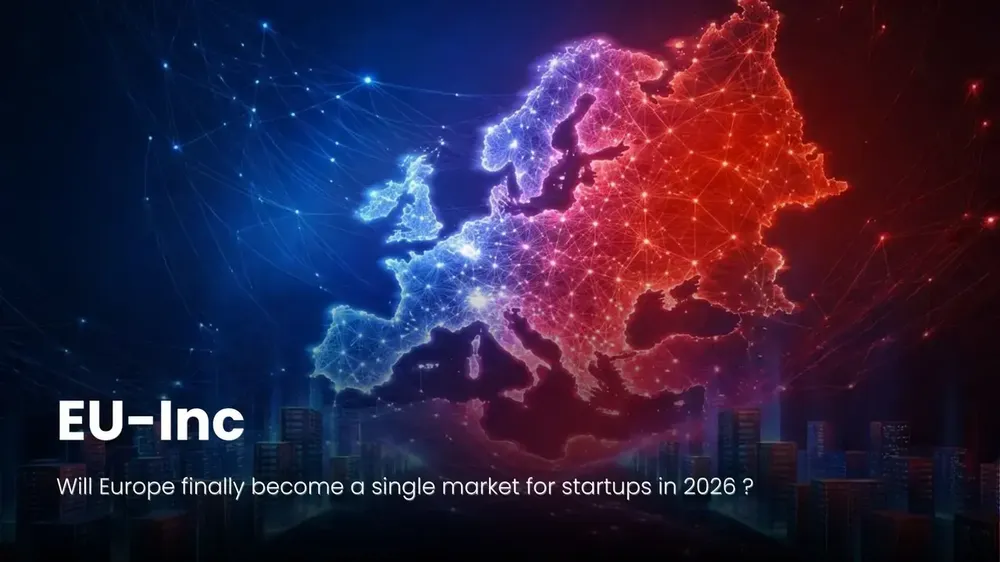
To concretely illustrate what the future European structure EU Inc. could change, two partners from the international audit and consulting firm PwC, Johannes Smits and Thibaut de Haller, imagined the journey of a fictional Agritech startup, GreenFields AI, facing the legal, tax, and operational realities of the single market. Their scenario highlights a well-known challenge for entrepreneurs: the complexity of building a business designed to operate at the scale of the continent.
From Bright Idea to Bureaucratic Reality
GreenFields AI is an imaginary company ready to transform agriculture. The challenges it faces, however, are very real. This Agritech startup has developed an artificial intelligence platform combining satellite imagery, soil data, and machine learning to help farmers reduce inputs while improving yields. The pilots are promising, farmers are showing interest, and investors are already envisioning the structuring of the operation.
Then comes the "easy" part: creating the company. Very quickly, the founders – three young leaders from France, Germany, and the Netherlands who met in one of the world’s top MBA programs – encounter one of the main obstacles for European startups: the legal, regulatory, and tax fragmentation of the market.
“Very quickly, the founders encounter one of the main obstacles for European startups: the legal, regulatory, and tax fragmentation of the market.”
Where to Create GreenFields AI?
France offers a strong agronomic pool. Germany brings industrial credibility. The Netherlands is known for being investor-friendly. Or should they look elsewhere — Estonia for administrative speed, Ireland for tax benefits?
Each option involves its own corporate law, tax rules, capital requirements, reporting obligations, and legal specifics. Talent matters. Capital matters. But understanding what one is legally committing to, and the difficulty of changing it, is equally important.
After weeks of research, discussions with lawyers, and spreadsheet comparisons, GreenFields AI is finally registered. The company starts its operations. The startup quickly gains visibility, particularly on LinkedIn, and begins to attract the attention of investors and partners. For a brief moment, bureaucracy seems to be behind them.
Growth: The Second European Obstacle Course
The product is gaining traction. A French cooperative wants a deployment. A German agricultural distributor is interested. A Spanish data specialist would be the perfect recruit.
As GreenFields AI grows, European fragmentation reminds them of its presence. Recruiting internationally raises new questions. Is a local entity required? What labor law applies? What reporting obligations exist? How to structure incentive compensation? Each country adds a new layer of rules, interlocutors, and costs.
Europe may have a single market for selling products, but to build and grow a business, everything is still done country by country. This is precisely the problem that the EU Inc. initiative aims to solve.
“As GreenFields AI grows, European fragmentation reminds them of its presence.”
What Exactly is EU Inc.?
Announced by European Commission President Ursula von der Leyen at the World Economic Forum in Davos, EU Inc. aims to reduce one of the main handicaps that Europe imposes on itself: the fragmentation of the corporate legal framework.
The principle is simple: create a harmonized form of European company that startups and growth companies could use to operate throughout the Union under a single legal framework.
Instead of being established under national law — French, German, Italian, or Dutch — companies could opt for a pan-European structure with common rules.
EU Inc. Should Offer:
For startups, EU Inc. means fewer decisions dictated by the complexity of national rules, and more guided by strategy and market.
“For startups, EU Inc. means fewer decisions dictated by the complexity of national rules, and more guided by strategy and market.”
Why It’s Crucial for Agritech Startups
Agritech companies often start locally, testing their solutions on specific regions or crops, but quickly expand internationally. Climate challenges do not stop at borders, nor do food supply chains.
Today, scaling means constantly adapting to new legal environments. EU Inc. would allow startups like GreenFields AI to think European from day one, rather than piecing together national structures as they grow.
And then there’s the topic that founders know well: stock options.
Stock Options: Finally Simplified?
Stock options are essential for attracting talent. In Europe, they are also notoriously complex.
Each country applies different tax treatments, reporting rules, and compliance requirements. Granting options to employees in France, Germany, and Spain can feel like managing three distinct companies.
One of the most attractive promises of EU Inc. is the possibility of a more harmonized framework for stock options. If well implemented, it would allow for granting shares or stakes to teams in multiple countries without having to navigate entirely different systems each time. For founders: less legal complexity. For employees: more clarity. For startups: a better ability to attract top talent.
It’s not glamorous, but it’s fundamental.
“One of the most attractive promises of EU Inc. is the possibility of a more harmonized framework for stock options.”
What EU Inc. Is… and Is Not
EU Inc. will not eliminate all national differences. Labor law will remain local. Taxation will continue to vary on many aspects. And the framework will be optional – companies will still be able to incorporate at the national level if they wish.
But EU Inc. brings something that has long been missing in Europe: a credible and suitable alternative for startups. It is designed for companies that want to grow internationally, not just survive their first year.
A Surprisingly Ambitious Timeline
Unlike many European initiatives, EU Inc. comes with a relatively clear and ambitious timeline. Ursula von der Leyen indicated that the proposal could be submitted for a vote in the European Parliament as early as March. If approved and implemented as planned, companies could start using EU Inc. as soon as 2027. At the Brussels level, this is particularly ambitious.
In a global race dominated by the United States and China, which offer much more harmonized environments, Europe can no longer afford to unnecessarily complicate business growth.
“The need for simpler rules to build businesses in Europe is very real.”
The continent has strong Agritech innovation, world-class research, and ambitious climate goals. What it lacks is a legal structure that matches this ambition.
EU Inc. will not solve all the challenges of European startups. But it addresses one of the most structural: the fragmentation of the single market. GreenFields AI offers a case in point. The need for simpler rules to build businesses in Europe is not fiction. It is very real.

14 August 2026
Aurore Dupont - 17 June 2026
Aurore Dupont - 4 June 2026