Anne BarratPublished on 10 August 2026
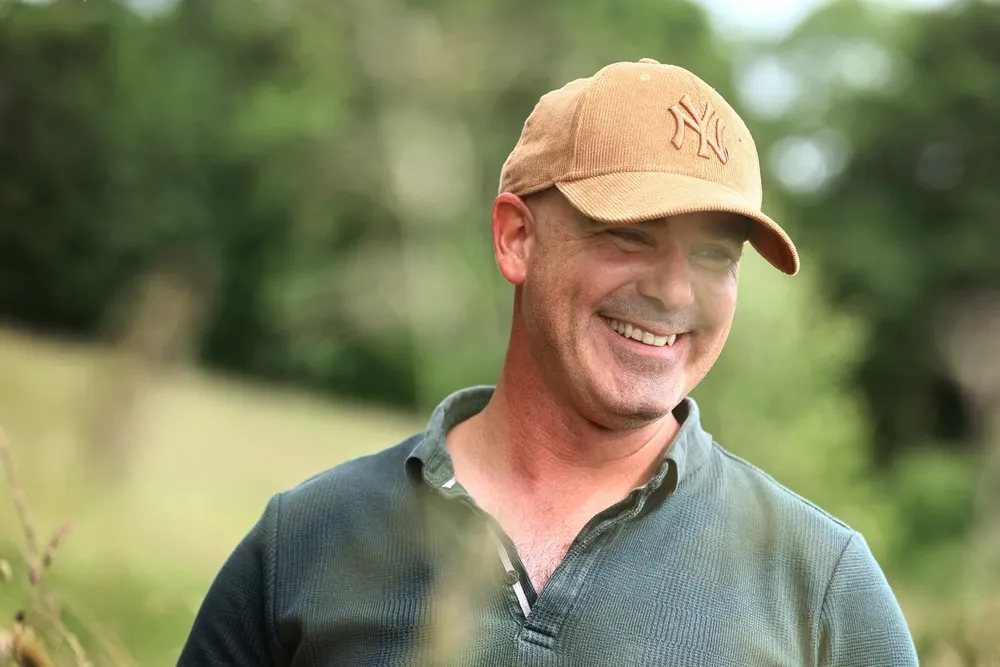
Manager of the Charente nursery Quercus, specialized in oaks and collection botanical species, Vincent Brunet started at the age of twelve and has made it his profession ever since. He has just acquired one of the largest collections of oaks in France. He speaks of trees as living beings of great intelligence, who communicate, help each other, and suffer. His diagnosis is bleak: climate disruption is gradually threatening our endemic forests. His conviction, however, remains bright: "I always wake up in the morning with a smile." Because where others see a dead end, this enthusiast sees a project, that of the forest of tomorrow. Interview.
Bloom Agritech: Since childhood, you have been involved in tree cultivation, particularly oaks. What has struck you the most in the last thirty years?
Vincent Brunet: A shift that I observe in real time. Last year, while cycling down towards Cahors, I heard the leaves crackling like chips as I passed through the woods. This season, they are wilting before my eyes. Never in my career have I seen this: we have moved from occasional climatic accidents to a fundamental decline.
Rather than pointing to "global warming," you speak of "disruption." Why?
The difference is essential. The public debate only focuses on the heat effect, while two phenomena are at play: constant heat – temperatures are tending towards permanent 35-40 degrees – and peaks that cause real burns. The real danger is the oscillation. In the past, a peak of 40-42 degrees lasted a week, followed by two months of normal heat: a simple heatwave. This year, we are already at the fourth, increasingly close together, and not a drop of water has fallen. No residual humidity, no capillary rise, no evapotranspiration: the water cycle is broken.
" We have moved from occasional climatic accidents to a fundamental decline"
What happens to a tree during these peaks?
It undergoes what foresters call a "crown descent." Its leaves scorch, as if a hairdryer were being used on the forest. The tree then suppresses part of its sap in its aerial volume: a defensive reflex to limit photosynthesis and transpiration. But each episode costs it three to five years of growth. Three consecutive heatwaves, and it loses the equivalent of fifteen years: it is doomed. At 52 degrees, the forest literally burns. On the ground, this heat kills all microbial and fungal life, the mycelium, which is the communication tool between plants. So it is not just a question of trees, but of ecosystem.
" Each episode costs it three to five years of growth"
Why is it so important to think on the scale of the ecosystem?
Because the forest is a social organism. The oak, thanks to its taproot, is a true well-digger: it seeks water deep down. When the perennial plants, the most sensitive, begin to suffer, they warn, via the mycelium and the root system, that a heatwave is coming. The oak blocks its photosynthesis, pumps the water, brings it up to the crown, and diffuses this coolness to all the neighboring vegetation. Everyone helps each other. Hence my insistence on the ecosystem and differentiated management: by reintroducing a plant cover to the ground, a shrub layer, and a canopy, we recreate a balance. The pioneers of agroforestry, on one hectare of market gardening worked in five layers, achieve a yield three times higher than the conventional, without fertilizers, with very little watering. Everything is connected.
" The pioneers of agroforestry, on one hectare of market gardening worked in five layers, achieve a yield three times higher than the conventional"
So, should we change the species in our forests?
We will always have oaks – there are 460 varieties in the world, more than a hundred in our country – but they will no longer be the same. A century ago, an oak would "move" 150 kilometers per century, through natural seed dispersal; today, only a kilometer and a half. This chain has been broken by the accumulation of many phenomena: industrialization, pesticides, the uprooting of hedges, the enlargement of fields. Oaks from southern Eurasia or the Atlas should have naturally reached us; they did not come. We have already cultivated them, and their resistance is incredible.
" We will always have oaks, but they will no longer be the same"
What makes a variety more resistant?
Its origin. Take the Mexican oak Quercus hypoleucoides: since the beginning of the year, we have only watered it four times. A camel. Not a leaf has wilted. Tough, waxy, slightly fuzzy, it transpires very little. This is what saves this oak variety in situations of water stress. It is crucial to measure this "transpirability" of plants; Inrae in Bordeaux has started to study it. In contrast, the beech transpires a lot: it is in danger. The common ash and the elm, in our region, are clearly doomed. The paradox is that the varieties that will save us have long been labeled as "exotic," even "invasive." The nurseryman who trained me and passed on my passion for plants had cataloged all the species introduced in France in the 18th century. We were seen as crazy. Many are now proving to be exceptionally resistant. Since nature no longer propagates them, my job is precisely to create micro-populations to collect their seeds and restart, on a large scale, this interrupted dispersal. This is the whole purpose of the Quercetum, this oak conservatory that I am developing with the Charlois fund: an open-air arboretum, coupled with seed plots intended to produce the species of tomorrow.
" The beech is in danger. The common ash and the elm, in our region, are clearly doomed. The varieties that will save us have long been labeled as "exotic," even "invasive""
With this experience of resistant species, what is your view on large monoculture plantations, like the Landes forest?
Without beating around the bush: this type of forest is an ecological disaster, it is evident. Canada experienced this with its hundreds of thousands of hectares of eucalyptus: one match, and the fire burns for two months. Some fires in 2022 or 2023 only went out last year. A fire often starts from nothing: a vehicle on the roadside, grasses igniting, ferns, then wood. About 4,000 hectares later, everything has burned. Why did nothing happen? For economic reasons: pine grows quickly, it is profitable, convenience prevails. This is the nature of the human species.
" Large monoculture forest plantations are an ecological disaster "
Conversely, how can one recognize a well-designed forest?
By a symbiosis. Large trees on a mowed lawn in full sun, and I will spend my time watering; in ten years, I will still be there. It is better to quickly install a tree layer and a shrub layer, allow natural fallows to grow, and work with differentiated management. The shrubs provide shade at the base of the large trees and mitigate heatwaves. It is not the oak that gives everything to the others: it is a true cooperation between animals, plants, and plants among themselves. No single model, but always diversity and mutual aid.
What will the forest you are preparing for tomorrow look like?
A more diverse, more resilient forest, designed for the long term. What we sow today may only be useful in two or three centuries, and that is precisely what makes me optimistic. Nature has solutions, provided we help it. We work for people we will never know: there is no more beautiful profession.
" The forest of tomorrow must be more diverse, more resilient, designed for the long term "
Anne Barrat - 12 August 2026
Anne Barrat - 12 August 2026

Anne Barrat - 11 August 2026