Loading Bloom Agritech...

Subscribe to the newsletter
© 2026 Bloom Agritech. All rights reserved.
Loading Bloom Agritech...
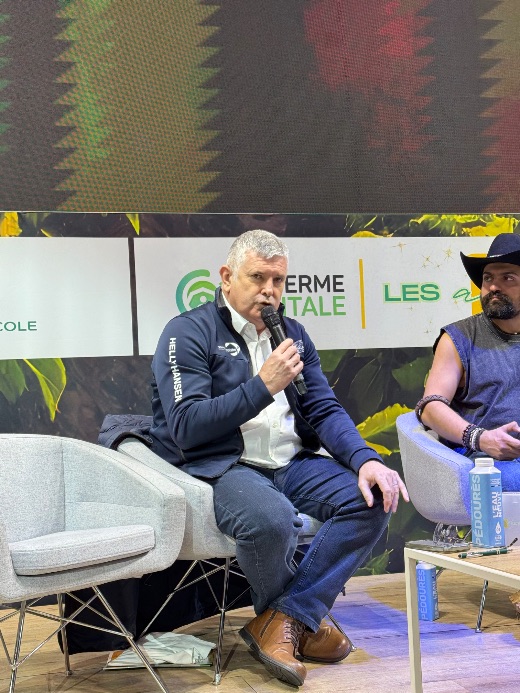
For Laurent Favreau, Vice President of the Vendée Departmental Council and President of SyDEV (Departmental Energy Union of Vendée), the issue of water has become central. In a territory that has neither rivers nor large streams, anticipation is a necessity. Since the 2000s, the department has implemented a collective water management strategy bringing together farmers, local authorities, agricultural sectors, and environmental associations.
As a result: today, Vendée can rely on 55 million m³ of water stored in its dams, 4 million m³ in old quarries, and 23 substitute reserves intended to secure agricultural and environmental uses. This policy is part of a broader vision for the territory: with 250 kilometers of coastline, Vendée is also oriented towards the ocean and carries this environmental commitment through a world-renowned event, the Vendée Globe, which has also become a platform for raising awareness and collecting scientific data on the oceans.
These statements were made during a round table organized at the 2026 International Agricultural Show by La Ferme Digitale, which is celebrating its tenth anniversary this year. Also present were Jérôme Leroy and Justine Lipuma, respectively President and Vice President of La Ferme Digitale, as well as Serge Zaka, an agroclimatology specialist.
Anticipate rather than suffer
In Vendée, water management has not been built in urgency. Since the 2000s, elected officials, farmers, agricultural chambers, and environmental associations have engaged in a collective reflection to anticipate tensions on the resource. For Laurent Favreau, "water management is primarily a collective issue. Politics, in the best sense of the term, is about bringing all the stakeholders of the territory to the table: farmers, sectors, local authorities, but also consumers."
In a territory marked by a strong hydrological particularity, anticipation has become a necessity. "Our reality? We do not have large rivers. In Vendée, 95% of the water comes from surface resources," recalls Laurent Favreau, meaning essentially rivers, dams, and reservoirs. "So necessarily, the question of its management arises differently." Faced with this structural constraint, Vendée chose to act early. "We asked ourselves, recalls the elected official: how to anticipate water management for the next twenty or thirty years? How to secure agricultural production and the food sovereignty of the territory?"
Water storage at the heart of the system
The Vendée response has been built around storage and the collective organization of the resource. Today, the department can rely on a significant network of infrastructures: dams, substitute reserves, and storage capacities in old quarries. "We took the bull by the horns," asserts Laurent Favreau. "As with energy, we decided to produce and store." The territory now has 55 million cubic meters of water stored in dams, plus 4 million cubic meters in quarry reserves, as well as 23 substitute reserves spread across the territory.
Contrary to some criticisms, these systems do not only serve intensive agriculture. "We must not think that the stored water is only for corn. That is false. It also serves market gardening, organic farming, and crop diversification."
According to the Vendée elected official, this collective management has also improved the hydrological situation of the territory. "Thanks to winter water management, groundwater levels have never been so high and the support capacities for low water levels have never been so significant."
A new water plan to adapt to climate change
However, Vendée officials are aware that the balances remain fragile. The acceleration of climate change requires adapting public policies. "Climate change is here. We see it every day. And farmers experience this unpredictability daily." The department has therefore launched a water plan of 40 million euros over four years, structured around four main priorities.
The first concerns the sobriety of uses. "Sobriety is something we cannot avoid. We must learn to use water better." The second axis is based on nature-based solutions, particularly the restoration of wetlands. "Wetlands have sometimes been damaged, but they have an essential hydraulic function. They need to be restored." The third pillar: water storage, which remains a sometimes sensitive subject in public debate. "Storage is not a dirty word. It does not only serve agriculture: it also serves biodiversity and even fire defense." Finally, the fourth axis concerns water quality, with projects for renaturation and restoration of hydraulic corridors.
"Storage is not a dirty word. It does not only serve agriculture: it also serves biodiversity
and even fire defense."
An ambition for territorial cooperation
For Laurent Favreau, the success of this policy relies primarily on cooperation among the territory's actors. "Farmers have their hands outstretched. They want to work with local authorities, with the State, and with environmental associations. Everyone has a role to play."
The goal is to move beyond caricatured oppositions around water use. "Our agricultural vision is not overproduction. It is the sharing of water, storage, and its valorization through the natural balances of the territory."
A territory oriented towards the ocean
Vendée also looks towards the sea. With 250 kilometers of coastline, the department is directly concerned by issues related to the oceans and rising waters.
The famous Vendée Globe offshore race also contributes to this environmental dynamic. "The Vendée Globe is a source of pride, but also a commitment. We want to make it a demonstrator."
During the last edition, scientific sensors were onboard the boats to collect data in the oceans. "Sailors deployed sensors around the planet to gather scientific information. This data can help us better understand and preserve the oceans."
For Laurent Favreau, the goal is clear: to make Vendée a territory capable of experimenting and sharing solutions to face climate challenges. "Vendée has always been a land of demonstration. And we want to continue to be."