Loading Bloom Agritech...

Subscribe to the newsletter
© 2026 Bloom Agritech. All rights reserved.
Loading Bloom Agritech...
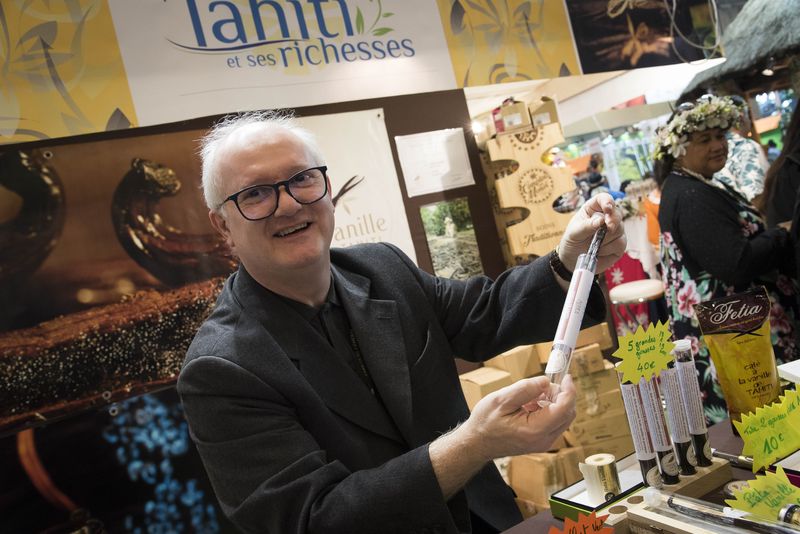
As part of the 6th Conference on French vanillas, held on February 17, 2026, at the Ministry of Agriculture in Paris with the support of the Ministry of Overseas Territories, Fausto Bouchereau, an expert engaged for over twenty years with producers, deciphered the mechanisms of an atypical market where issues of traceability, evolution of international standards, and a constant tension between quality and industrial standardization intersect.
For this child born in Paris in the 1960s, the relationship with vanilla is primarily a personal story. He remembers the pods his mother used every week in the kitchen, between English cream and rice pudding. A foundational sensory memory that, decades later, will lead him to French Polynesia, where he will rediscover the aromatic richness of vanilla and gradually engage with producers.
The world's first flavor, vanilla, relies on a market that is as opaque as it is volatile, with no official pricing or real price infrastructure. Capable of driving the price per kilo from $50 to over $600 in a few years, the sector evolves at the pace of cyclones, stocks, and the strategies of major buyers. However, behind this instability lies considerable development potential, a fragile balance that Fausto Bouchereau analyzes in the following interview.
Bloom Agritech: How would you describe the place of vanilla in the global flavor economy today?
Fausto Bouchereau: Vanilla is simply the world's first flavor used in the agri-food industry, accounting for about 35% of flavored products. About 90% of global production is intended for the manufacture of extracts to produce standardized flavors, while only 10% of the volumes are used in the form of whole pods by food professionals.
The vanilla sector is marked by a major paradox: the vast majority of what we consume is not natural vanilla. Synthetic vanillin represents over 40,000 tons per year and more than 90% of the market by volume. In contrast, global consumption of natural pods is around 3,000 to 3,200 tons, for a relatively modest value – less than $400 million at current prices.
"The vanilla sector is marked by a major paradox:
the vast majority of what we consume is not natural vanilla."
How do you explain that the world's first flavor is now predominantly synthetic?
It is primarily a question of cost: the gap is on the order of 1 to 100 between natural and synthetic. Alternative extraction technologies allow for the production in a few hours of what requires nearly a year with a natural pod.
Standardization also plays a crucial role. The industry needs a consistent taste, while natural vanilla varies constantly. Even when the pod is used, it is mainly to produce extracts and then natural flavors through dilution, allowing for a "natural" labeling even if the actual quantity remains low.
"The industry needs a consistent taste, while natural vanilla varies constantly."
What explains this break?
The break mainly comes from the rise in prices and the transformation of uses over the past twenty years. After several cyclones in Madagascar in the early 2000s, prices quickly exceeded $450 per kilo, then more than $650 between 2014 and 2018. When prices exceed about $350, demand from professionals drops sharply. Many food businesses have reduced their purchases. At the same time, knowledge of the product has gradually been lost.
Could this situation evolve?
A radical change is unlikely, but an evolution is possible. It would require more transparency and the acceptance of a price level that secures production and quality.
Who really drives prices today?
Major international buyers and traders play a decisive role. The market is highly concentrated and operates according to a direct negotiation logic aimed at buying at the lowest possible price.
Quality extraction lots can be purchased between $50 and $100 per kilo, then valued with margin coefficients of 10 to 15 once transformed into extracts or flavors. This financial logic often pushes to prioritize volume over quality.
"The market is highly concentrated and operates according to a direct negotiation logic
aimed at buying at the lowest possible price."
What price level would today allow for the sustainable stabilization of the market?
A level around $150 to $200 per kilo would secure supply and ensure fair remuneration for producers. Below $100, some plantations close. Above $350, demand drops below 2,000 tons.
Would the creation of an exchange be enough to set the "fair price"?
Vanilla currently operates like an over-the-counter market. Importers come to analyze the lots and negotiate directly with producers. There is no centralized pricing like for cocoa.
Before deregulation in the 1980s, exporters and buyers met in Paris once a year to set prices, which helped stabilize the market. Better regulation and more transparency would stabilize prices and improve the overall quality of production.
Why is the market so unstable today?
Instability is due to climate dependence, particularly cyclones in the Indian Ocean. Prices can vary by a factor of one to ten.
In 2025, global production was significant: Madagascar produced between 2,000 and 2,400 tons, followed by Indonesia (250 to 300 tons), Uganda (250 to 350 tons), and Papua New Guinea (100 to 150 tons). Current global stocks, around 1,000 tons, can barely cover 18 months of consumption.
The recent cyclone that hit the producing region of SAVA in Madagascar, as well as Réunion, could act as an additional tension factor on an already fragile market. Madagascar produces about 80% of the world's vanilla.
Can production be increased without sacrificing quality?
A comparison with cocoa is enlightening. Discovered around the same time in Mexico, the two products have had very different trajectories: since 1900, vanilla production has increased eightfold, while cocoa production has increased twenty-fivefold.
Today, vanilla supports between 125,000 and 150,000 growers, compared to nearly 5.5 million for cocoa. Yet, the production timelines are comparable, about five to six years. This shows the still largely untapped potential of the sector to create more wealth.
"Since 1900, vanilla production has increased eightfold, while cocoa production has increased twenty-fivefold."
Can the revision of international standards transform the market?
ISO standards define the sanitary and commercial rules of international trade. Under revision for three years, they should introduce a minimum vanillin threshold of around 1.8%, excluding lots of insufficient quality. These developments should raise quality and restructure the market, even if the main producing countries participate little in the work.
What place do French vanillas occupy today?
Between 1900 and 1960, France held nearly 70% of the global market. About 4% today. This legacy explains the persistence of solid know-how in the overseas territories, passed down through several generations. Today, French vanilla clearly positions itself in high value-added segments and represents about a thousand jobs, in a context marked by a structural supply deficit.
How do you envision the future of vanilla?
There is significant production potential in many tropical countries, but it will depend on investments and maintaining prices that allow producers to live from their activity. Like many agricultural raw materials, vanilla is at a pivotal moment today. Between structural volatility, pressure from major buyers, and tightening international standards, the sector is seeking a new balance. As technologies allow for better securing of flows, anticipating climate risks, and improving market transparency, vanilla could become a laboratory for agritech applied to high value-added sectors.
More than just a flavor, it reveals the tensions of a global market where economic, technical, and climatic issues intersect. It remains to be seen whether producers, industry players, and regulators will manage to build a sufficiently stable framework to reconcile quality, transparency, and sustainable development.