Loading Bloom Agritech...

Subscribe to the newsletter
© 2026 Bloom Agritech. All rights reserved.
Loading Bloom Agritech...
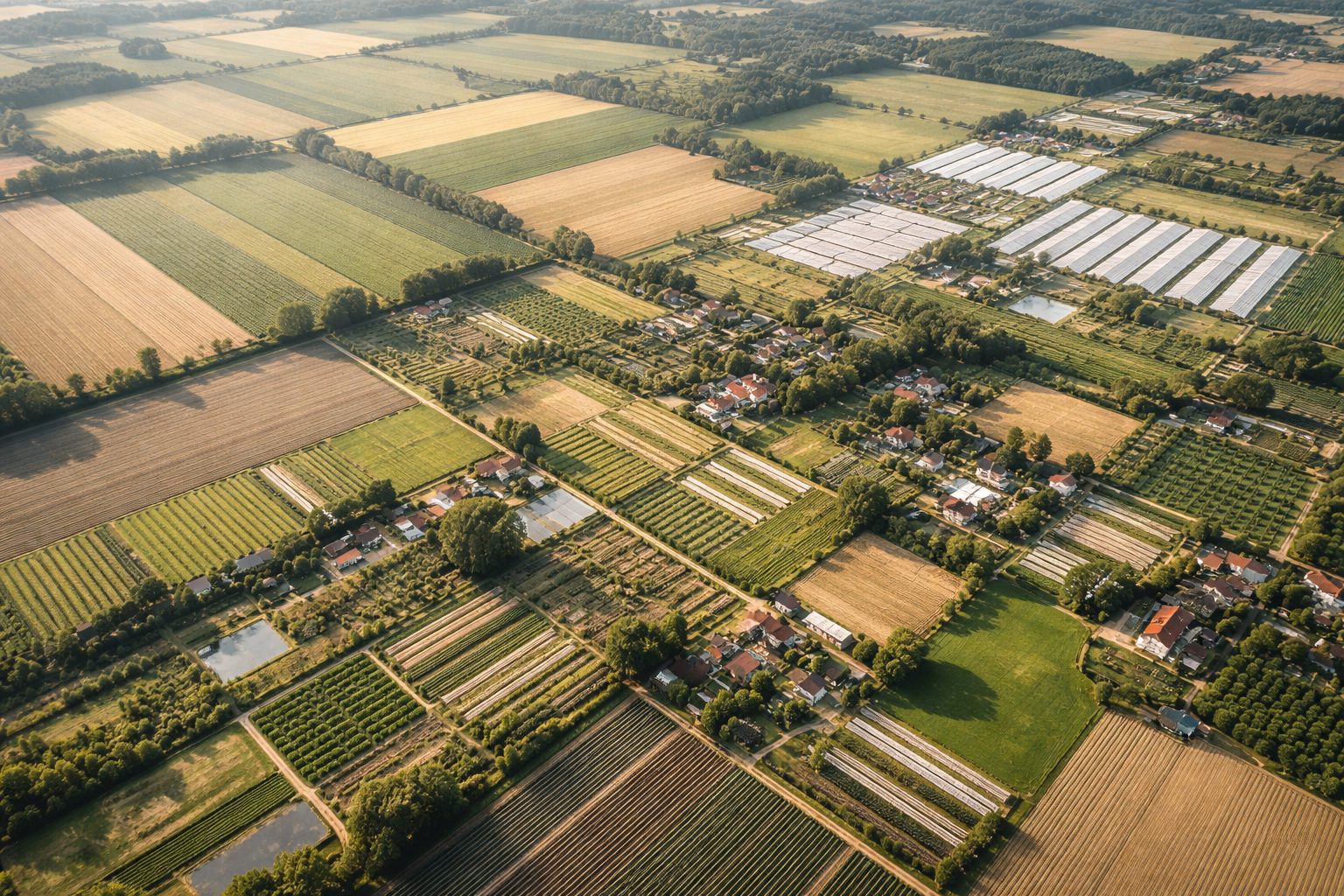
Long analyzed through the size of farms or their productions, French agriculture now appears structured by a growing diversity of entrepreneurial projects. This is highlighted by a study from the Centre for Studies and Prospective of the Ministry of Agriculture, based on data from the 2020 agricultural census, which offers a renewed reading of farms based on their economic, organizational, and managerial choices. The authors identify eight profiles of farms, grouped into four main poles:
The study draws inspiration from North American work onAgriculture of the Middle, which describes the fragilization of intermediate farms in a globalization context. By transposing this framework to the French case, the authors show that this vulnerability is not a national singularity, but the expression of a broader recomposition.
The proposed typology confirms that the transformation of the sector is no longer reduced to an opposition between family farming and industrial models. Farms now combine productive, heritage, and entrepreneurial projects, and increasingly operate as flexible businesses, capable of adapting their organization and investments to market, labor, and land constraints.
From family farm to flexible agricultural enterprise
For more than sixty years, the development of French agriculture has relied on the model of the family farm "with two UTHs," where capital, labor, and land were closely intertwined. This model, supported by political and fiscal institutions, has allowed for spectacular productivity gains: in sixty years, production has doubled with six times fewer active workers.
However, this success has been accompanied by a major paradox: the real value of agricultural production has declined by about 20%, due to international competition and the downward trend in prices. In the face of this pressure, the dominant strategy has relied on cost competitiveness: specialization, expansion, modernization. This has led to a profound recomposition of the agricultural landscape: from 2.3 million farms in 1955 to less than 400,000 in 2020.
This model is now reaching its limits, paving the way for more complex and differentiated forms of organization.
CAP, installation, advice: frameworks under tension
While the study does not directly formulate political recommendations, its results invite questioning of existing public frameworks. As farms change in nature, historical public frameworks are under tension, the CAP, designed for relatively homogeneous structures, struggles to grasp multi-company farms with multiple projects.
Installation and transmission policies are also affected. The rise of installations outside the family framework and non-linear entrepreneurial trajectories raises questions about the ability of existing mechanisms to support more diversified, but also more risk-exposed projects.
Finally, the transformation of farms calls for a redefinition of agricultural advice: economic management, risk management, legal engineering, and strategic support become central.
AI, robotics, and corporate agriculture: differentiated trajectories
The proposed typology offers a useful framework for understanding the diffusion of agricultural technologies. This diversity of profiles also sheds light, indirectly, on the differentiated diffusion of digital technologies, AI, and agricultural robotics. The most capitalized farms are naturally better positioned to integrate capital and data-intensive technologies. For others, these tools primarily serve as levers for resilience or income security.
Agricultural innovation does not produce uniform effects: its impacts are closely dependent on the models of farms and the economic frameworks in which they operate.
A necessary change of perspective
Underlying this work is the acknowledgment of the end of a single reference framework for French agriculture. The sector is evolving towards a coexistence of models, driven by diverse entrepreneurial strategies and increasingly flexible organizations. For public action, the challenge is no longer to defend a dominant model, but to recognize this plurality and adapt support tools to an agriculture that has become technological, collaborative, and differentiated.